Okay, sorry to stalk and drool over movie stars' private lives, but guess where Tom and Katie had their "rehearsal dinner?"
At the American Academy in Rome's Villa Aurelia, yet no less!
Seems it was hosted by the bride's parents, as is traditional.
And, good for them, because there's no way the paparazzi can get even CLOSE to the beautiful villa.
Friday, November 24, 2006
Wednesday, November 22, 2006
Pre Thanksgiving Racists: Kramer & US Airways
This foggy morning, I am greeted with news of Islamic clerics humiliatingly taken from their US Airways flight. It's all very disgusting, beginning with the ignorance of some passenger who mistook the men's evening prayers for some kind of pre-terrorist action. Said passenger passed a note to a flight attendant, apparently containing the phrase "Arabic men." US Airways chose to remove the men from the flight, handcuffed by police.
This chain of events full of intolerance and (at the very least) ignorance, comes on the heels of Michael Richards' bizarre racist retorts to a heckler at a comedy club.
Where to start? People, this is the day before Thanksgiving. Three hundred odd years ago, Native Americans took pity on a small group of struggling Anglo pilgrims who'd finally been able to clear a little farmland, and introduced them to their own harvest festival of giving thanks. The pilgrims were so fed up with English persecution of their religious practices, they took a dangerous sea journey to arrive in the New World just as winter was setting in. In the end, more settlers from the continent would bring disease and slaughter to the Natives, in general thinking of these established tribes as little more than inconveniences to their manifest destiny.
That's the thanks they get for giving us every American's favorite family weekend, the day we reflect on our blessings, on our good fortune, and, sometimes, on those less fortunate. Perhaps it's also time to think about that aspect of the holiday in which generosity, being a good host, and the tenets of equality in our country's constitution. Not tolerance. Equality.
What can we do?
1. Boycott US Airways
2. Learn about the Muslim faith, its pillars and practices, its leaders, communicators and families
3. Invite someone new to your Thanksgiving table
4. Make a contribution to a charity that promotes racial and religious respect
5. Do something that brings a little harmony between yourself and someone of another race or religion.
This chain of events full of intolerance and (at the very least) ignorance, comes on the heels of Michael Richards' bizarre racist retorts to a heckler at a comedy club.
Where to start? People, this is the day before Thanksgiving. Three hundred odd years ago, Native Americans took pity on a small group of struggling Anglo pilgrims who'd finally been able to clear a little farmland, and introduced them to their own harvest festival of giving thanks. The pilgrims were so fed up with English persecution of their religious practices, they took a dangerous sea journey to arrive in the New World just as winter was setting in. In the end, more settlers from the continent would bring disease and slaughter to the Natives, in general thinking of these established tribes as little more than inconveniences to their manifest destiny.
That's the thanks they get for giving us every American's favorite family weekend, the day we reflect on our blessings, on our good fortune, and, sometimes, on those less fortunate. Perhaps it's also time to think about that aspect of the holiday in which generosity, being a good host, and the tenets of equality in our country's constitution. Not tolerance. Equality.
What can we do?
1. Boycott US Airways
2. Learn about the Muslim faith, its pillars and practices, its leaders, communicators and families
3. Invite someone new to your Thanksgiving table
4. Make a contribution to a charity that promotes racial and religious respect
5. Do something that brings a little harmony between yourself and someone of another race or religion.
Monday, November 20, 2006
Berkeley High, class of 1976
Okay, this weekend I attended the 30 year reunion of BHS graduates in the year 1976. Technically, I am in the class of 1977, because I was born in 1959 and started Kindergarten in 1964, but I decided to graduate early in '76.
That last year of school was a toughie, because, due to a long teachers' strike, I did not begin fall semester until well into October. I struggled with Algebra 3, quit attending the classroom sessions, but neglected to drop the course formally. Thus, I earned a "D" and pushed out my chances of getting into the University of California.
I WAS more timely in those matters such as getting my graduating picture into the yearbook, though. So, there sits my image in the 1976 tome, as if I'd always belonged to the cool class of Tom Schaaf, Timothy Hutton, Tom Levinson, Sabrina Stemley, Oriane Stender, Mordecai Duckler, and Liz MacDonough. Fooled everyone as usual and showed up at the clubhouse at Golden Gate Fields in time for no-host bar, caloric buffet, and a roomfull of people who needed reading glasses to peruse each others' name tags.
First contact was Margaret Leventhal, who looks the same but appears a good bit less butch than she used to, there in Mr. Panesanko's Advanced Biology class. She's a mom, now, too (got started twenty years later than I did), and she has a nice husband. Next, I ran into Bonnie Sand (that's Doctor Sand to you and me) and she linked me over to her ever-best-friend, Leslie Ross. Holy cow, Leslie went to Cooper Union! And she's working at Gulassa & Co in Seattle! Small world! Avram Siegal was there, too (the guy with the banjo), and he's managed to do the amazing: make money as a musician! Thanks for the glass of wine, Avram.
Utterly incredible to see John Stenmark, who seemed merely tall (not gigantic, as he appeared in high school). He's been living 20 years in Barcelona, of all places.
Renata Dowdakin said hello, but just to tell me that her brother wound up at the American Academy in Rome, at the time under my dad's directorship. She was one of at least a dozen women there who were remarkably well-preserved, fit, and beautiful. Winning the handsomest guy award was Don Teeter, trumpeter with the venerable BHS jazz band. Kind of fun to see one stoner guy who will go unnamed; he's a total "suit" now, strutting in with young eye candy on his arm. High tech jobs topped the career tally, including the principal's uber jock son, Eric Parker. I guess he lived in Singapore for a while, around the time I was in Honkers.
I missed the raucous display of dances, but I couldn't miss hearing "Don't Rock the Boat" and other disco disasters being broadcast at 100 dB. I think everyone was hoarse the next day, for we all had to shout to be heard. Finished up at midnight, chuckled all the way home. Sorry that quite a number of cool kids did not show up, but I can see that the $80 ticket price was an automatic filter.
In all, a fun reunion. Thanks especially to Bonnie and Leslie for showing up.
That last year of school was a toughie, because, due to a long teachers' strike, I did not begin fall semester until well into October. I struggled with Algebra 3, quit attending the classroom sessions, but neglected to drop the course formally. Thus, I earned a "D" and pushed out my chances of getting into the University of California.
I WAS more timely in those matters such as getting my graduating picture into the yearbook, though. So, there sits my image in the 1976 tome, as if I'd always belonged to the cool class of Tom Schaaf, Timothy Hutton, Tom Levinson, Sabrina Stemley, Oriane Stender, Mordecai Duckler, and Liz MacDonough. Fooled everyone as usual and showed up at the clubhouse at Golden Gate Fields in time for no-host bar, caloric buffet, and a roomfull of people who needed reading glasses to peruse each others' name tags.
First contact was Margaret Leventhal, who looks the same but appears a good bit less butch than she used to, there in Mr. Panesanko's Advanced Biology class. She's a mom, now, too (got started twenty years later than I did), and she has a nice husband. Next, I ran into Bonnie Sand (that's Doctor Sand to you and me) and she linked me over to her ever-best-friend, Leslie Ross. Holy cow, Leslie went to Cooper Union! And she's working at Gulassa & Co in Seattle! Small world! Avram Siegal was there, too (the guy with the banjo), and he's managed to do the amazing: make money as a musician! Thanks for the glass of wine, Avram.
Utterly incredible to see John Stenmark, who seemed merely tall (not gigantic, as he appeared in high school). He's been living 20 years in Barcelona, of all places.
Renata Dowdakin said hello, but just to tell me that her brother wound up at the American Academy in Rome, at the time under my dad's directorship. She was one of at least a dozen women there who were remarkably well-preserved, fit, and beautiful. Winning the handsomest guy award was Don Teeter, trumpeter with the venerable BHS jazz band. Kind of fun to see one stoner guy who will go unnamed; he's a total "suit" now, strutting in with young eye candy on his arm. High tech jobs topped the career tally, including the principal's uber jock son, Eric Parker. I guess he lived in Singapore for a while, around the time I was in Honkers.
I missed the raucous display of dances, but I couldn't miss hearing "Don't Rock the Boat" and other disco disasters being broadcast at 100 dB. I think everyone was hoarse the next day, for we all had to shout to be heard. Finished up at midnight, chuckled all the way home. Sorry that quite a number of cool kids did not show up, but I can see that the $80 ticket price was an automatic filter.
In all, a fun reunion. Thanks especially to Bonnie and Leslie for showing up.
Thursday, November 09, 2006
Stuff One Forgets, Stuff One Remembers...
How did I forget this oddity from the night of October 12, last month?
I took a taxi from the Protestant Church in Legian after the terrorist bomb memorial there. The taxi driver was from Sumatra, interestingly. His English was not great, but certainly passable for a driver's work. Soon after we struck up a conversation, he passed back to me several sheets of paper for my perusal. He wanted to know what I thought of his new t-shirt design.
Now, for the life of me, I cannot remember the exact text that was printed on each of about fifty t-shirt mockups. All I can be sure of is that there were two words, and one of them was Sex. The other word was English, all right, but it made no grammatical sense to be paired with Sex. It was something like Sex Above or Sex Catching or Sex Frame or even Up Sex or Fever Sex or Very Sex or something incredibly stupid like that.
Friends, I was speechless. Yes, this motormouth had almost nothing to say. This was jaw-drop time. I leafed through his computer printouts of camo shirts, assymmetrical neckline shirts, babydoll shirts, tank tops, and any t-shirt you can possibly imagine, all with this inane and actually rather offensive message emblazoned in myriad fonts.
Here it was, the day that shook Bali to its very core. The day that a total of 202 partygoers and their drivers, waiters, bartenders, and entertainers were killed by a terrorist's bomb. The day we reflect on the tragedy, on intolerance and hatred, on war, and on the upheaval in the lives of victims' families.
I have always been one to say, "don't let the bad guys win by moping and pulling back inside yourselves. Get out there and flourish and prosper." Right after the bomb went off, or at least two weeks later, we went ahead with our open house, welcoming friends into our new Bali home. My reasoning was that life MUST go on. Living is the greatest revenge. BUT I also had the thought, right away, when Cakra told me about the bomb, that it was the work of Jamaiah Islamiah. (spelling). I thought that if someone wanted to make a statement against decadent infidel living, they'd hit a nightclub. It turned out to be true, sadly enough.
Now, I don't go in for the clubbing scene, but it's perfectly fine with me that we have a nightclub district (or two) for this sort of fun. There is nothing wrong with footballers going to a bar to celebrate sportsmanship, with girls going out dancing wearing skimpy outfits, or with people relaxing with a drink in hand. But some people find this so objectionable, so intolerable, that they feel compelled to kill them for doing this. That's disgusting.
I am not saying that we should listen to terrorists. But I am saying that for the divide to have become this great, for the hatred to have developed this perversely, it may be time to really reflect on what it is to get along with others. The boys growing up in Baashir's school are being taught that getting along with others is not as important as imposing a strict code of behavior on the world. There may, conversely, be something to think about vis-a-vis public drunkenness and carousing. The partyers at the Sari Club were certainly within the confines of an establishment purpose-built for drinking and dancing and maybe even picking up chicks. They did not "deserve" to suffer for this behavior. But it does make us think, "what are westerners capable of doing, or changing, to make this world a more harmonious place?" If we were better friends to other nations, other peoples, perhaps they would not mind so much that we like to drink and wear shorts and have premarital sex.
Anyway, back to the t-shirts. I told the driver, after some thought, after trying to compose a diplomatic response, after mourning dead night clubbers, the following... "There is only one kind of girl who would wear this shirt. Not everyone will want to have this message on their shirt." I think he got it.
I took a taxi from the Protestant Church in Legian after the terrorist bomb memorial there. The taxi driver was from Sumatra, interestingly. His English was not great, but certainly passable for a driver's work. Soon after we struck up a conversation, he passed back to me several sheets of paper for my perusal. He wanted to know what I thought of his new t-shirt design.
Now, for the life of me, I cannot remember the exact text that was printed on each of about fifty t-shirt mockups. All I can be sure of is that there were two words, and one of them was Sex. The other word was English, all right, but it made no grammatical sense to be paired with Sex. It was something like Sex Above or Sex Catching or Sex Frame or even Up Sex or Fever Sex or Very Sex or something incredibly stupid like that.
Friends, I was speechless. Yes, this motormouth had almost nothing to say. This was jaw-drop time. I leafed through his computer printouts of camo shirts, assymmetrical neckline shirts, babydoll shirts, tank tops, and any t-shirt you can possibly imagine, all with this inane and actually rather offensive message emblazoned in myriad fonts.
Here it was, the day that shook Bali to its very core. The day that a total of 202 partygoers and their drivers, waiters, bartenders, and entertainers were killed by a terrorist's bomb. The day we reflect on the tragedy, on intolerance and hatred, on war, and on the upheaval in the lives of victims' families.
I have always been one to say, "don't let the bad guys win by moping and pulling back inside yourselves. Get out there and flourish and prosper." Right after the bomb went off, or at least two weeks later, we went ahead with our open house, welcoming friends into our new Bali home. My reasoning was that life MUST go on. Living is the greatest revenge. BUT I also had the thought, right away, when Cakra told me about the bomb, that it was the work of Jamaiah Islamiah. (spelling). I thought that if someone wanted to make a statement against decadent infidel living, they'd hit a nightclub. It turned out to be true, sadly enough.
Now, I don't go in for the clubbing scene, but it's perfectly fine with me that we have a nightclub district (or two) for this sort of fun. There is nothing wrong with footballers going to a bar to celebrate sportsmanship, with girls going out dancing wearing skimpy outfits, or with people relaxing with a drink in hand. But some people find this so objectionable, so intolerable, that they feel compelled to kill them for doing this. That's disgusting.
I am not saying that we should listen to terrorists. But I am saying that for the divide to have become this great, for the hatred to have developed this perversely, it may be time to really reflect on what it is to get along with others. The boys growing up in Baashir's school are being taught that getting along with others is not as important as imposing a strict code of behavior on the world. There may, conversely, be something to think about vis-a-vis public drunkenness and carousing. The partyers at the Sari Club were certainly within the confines of an establishment purpose-built for drinking and dancing and maybe even picking up chicks. They did not "deserve" to suffer for this behavior. But it does make us think, "what are westerners capable of doing, or changing, to make this world a more harmonious place?" If we were better friends to other nations, other peoples, perhaps they would not mind so much that we like to drink and wear shorts and have premarital sex.
Anyway, back to the t-shirts. I told the driver, after some thought, after trying to compose a diplomatic response, after mourning dead night clubbers, the following... "There is only one kind of girl who would wear this shirt. Not everyone will want to have this message on their shirt." I think he got it.
Sunday, November 05, 2006
Somebody Else Did All the Talking
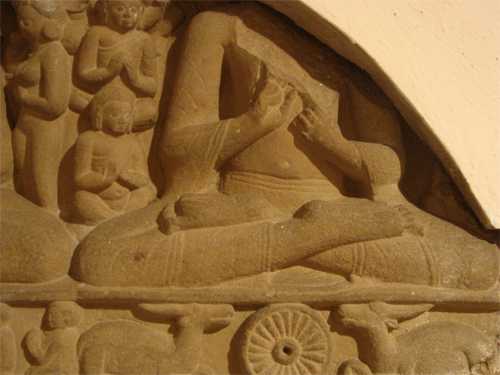
So here's Buddha. Like me, he spent a little time in India.
Well, I just got back a couple of weeks ago. Buddha didn't have jet travel and a house waiting for him in Bali.
Great teacher, I see this image of you, and it makes me think about the problems of being misunderstood.
I know that you were a person of great accomplishments. You tried a number of ways to get out of the cursed cycle of Samsara. You found a workable method. You taught it to as many people as you could. This art tells me that you were in the Deer Park at Sarnath, and your hand mudra tells me that you were teaching. The muscular depiction of your body tells me of the aesthetics of the cultures that succeeded the era of your physical life. They liked the wrestler's body. Even Jain saints and Hindu gods have that body. A pleasing rendition of the human form.
I see that somewhere along the timeline, a thief came and hacked off the head that was meant to portray your great mind, your calm mood, and your very important image. People love pictures. People are compelled to illustrate. They like to have mementos and images. You left the earth asking that no one idolize or iconographize you, but it was only a matter of a hundred years before your followers couldn't resist making images of you.
Even today, people bow down to your image. I keep a number of artifacts of your image, nothing really valuable, but I like them. They make me think of you and your lessons. The image is instantly recognizable to people of many nations. In many ways, the image is more important to people nowadays, than your lessons.
You had something to say, it got reinterpreted and diluted, and maybe there's a little less of you around because of that.
I know what it's like to have something to say, but to have it sit silently tucked away somewhere. No one asked me, no one wanted to know. There was a lot of talk all around me, but I didn't say anything. My head may as well have been hacked off. I just sat there. I was misinterpreted.
Monday, October 30, 2006
Happy Diwali, 2006
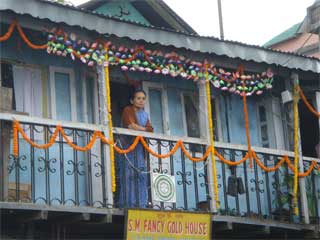
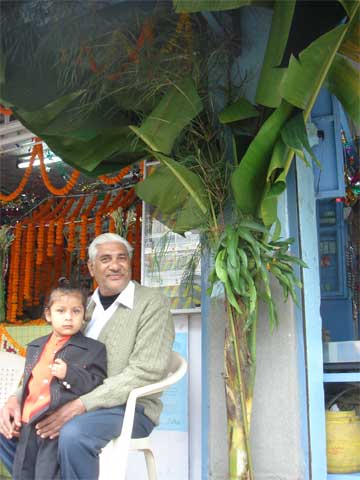
Darjeeling is just as fun on Diwali as Aurangabad, 1997, or Jaipur, 2001.
These festive decorations made a foggy day an absolute delight!
Saturday, October 14, 2006
Remembering the 2002 Bali Bomb
So it was four years ago, the bomb that all but ruined the tourist industry in Bali, the bomb that killed 202 people from 22 countries.
I had to go pick up my man from the airport, so I just left several hours early and went straight to Kuta beach, site of the blast.
I was to learn something about how people choose to memorialize tragedies.
I wandered down to the area near the Hard Rock, where, crowded in a small swath of the wide sand beach, maybe 1,000 people were gathering for one of the memorials in the area. This was the Billabong Paddle for Peace rally. In this day and age, it is no big deal, I guess, for a peace rally or memorial to have a commercial sponsor. Oh well.
I was overdressed, as usual, in linen shirt and trousers, holding my sunblock umbrella against the setting sun. Everyone else was dressed for a beach party... bikinis, shorts, tattoos, etc. There were also about ten or fifteen local ladies in lacy kebayas and batik sarongs (pakaian adat). A number of kids raced around, scooping up flower petals and tossing them. Maybe 100 surfers sat in rank and file with their boards, festooned with flower petals and looking like some kind of warriors or human sacrifices... up higher on the sandy slope they did have a kind of altitude over the rest of us. I waited in the crowd, up near a white cloth "wall", taking in the ceremony. All seemingly very casual, but planned and orchestrated. To my embarassment, they played the Australian national anthem on the PA, followed by a highly sappy version of Waltzing Matilda, all verses, and then the great Aussie ballad True Blue.
Possibly the most obnoxious moment was courtesy of some helicopter company, which sent a copter roaring over to the ceremony area, hovering over the shore break at a frighteningly low altitude and even more frighteningly high decibel level. Drunk and carefree participants waved at the chopper like it was an angel from heaven, or at least a good pal.
Many of those present were drinking from bottles of Bintang Beer. Many gals (even, horrors, my age) were cavorting like pinup girls in revealing bikinis. I had invaded an Australian memorial! Kids let loose turtles in the sea, we were asked to introduce ourselves to the people around us, and there was a moment of silence at sunset, while the surfers who'd paddled out to form a circle just past the breakers, held hands.
I was moved by the beautiful sunset, by the candles we each were given, and by the 22 gongs for the 22 nations who lost people. But I felt like an intruder in a party to which I was not invited, when I had to sit through True Blue and the anthem. A strange mix of sombre sacred and party hearty profane.
Perhaps craving a show of dignity, I grabbed a juice at the Harris Hotel and went to the Legian Protestant Church to take in the ceremony there. Olga of the Bali International Women's Association had sent me an email notice of this memorial. And, all being welcome, I decided to go there and pay some Christian style respects to the innocents killed by the bomb.
The church service was on the order of charismatic Christianity, with lots of songs about love, no hymns, and a Power Point illustrative slide show to help us see the words of songs and prayers, in Indonesian as well as English, with dreamy renditions of nature, the bomb site, and Jesus. Christians from all over the island took part, and there was even an interpretive dance about faith in Jesus.
There was St Francis of Asisi's prayer, about being an instrument of God. Yeah, inspirational, I suppose, but very humble in that turn-the-cheek way. "Nothing we can do about it" was the attitude, and may as well take comfort in the fact that Jesus loves us, and so on. A sucker for dramatic lighting, I was moved by the candle lighting ceremony in the dimmed church (a cute white Balinese style structure without walls), but that darned synthesizer continued to wail music during our 2 minutes of silence.
Funny thing, the noise factor. I'm clinically 40% deaf, and yet I am keenly aware of the lack of true silence. The chopper, the synthesizer, dogs barking, chickens crowing... Bali may never find peace.
So really I got to see how amazingly different people can be in memorializing victims and remembering a tragedy. Both ceremonies taking a fairly light touch, despite the glaring overtones of Jesus and Australia. No acrimony toward the perpetrators, not even a hint of their horrible act of murder. I was not directly affected by the bomb at the Sari Club those 4 years ago, but I have always viewed the event with disgust. Sometimes anger, but I can imagine only a fraction of the anger that victims' families must feel. If I'd been simmering in vengeful and sorrowful thoughts for four years, would I take any comfort in an Aussie beach singalong and an evening of lightweight Jesus songs?
Strange capper to these events was watching a tape on the Discovery channel called Bombali, aired on our satellite network and taped by me so that I could watch it yesterday. Very unabashedly presenting the party and pickup scene at the Sari Club that fateful night.
Dig, the bombers were portrayed as misled robots in a ridiculous but well planned mini jihad against immoral white people, but there was no hesitation to show that the Sari Club was a good place for revelling football players to pick up cute young backpackers. Look, I feel it's anyone's right to go to bars and drink and even get drunk if you feel like it, which are actually big aspects of the Australian social life. If you go to a beach town and see a lively bar, packed with celebrants from a weekend of sporting events, why NOT go in? But to hear several interviews with witnesses and victims' families, many dressed as skimpily as western culture allows, was at moments a little embarassing.
Fact: there are a bunch of Muslims who think I'm immoral for having my wine with dinner last night, for wearing this sleeveless shirt today, and for not believing that there is one true God whose prophet was Mohammed. Fact: there are a bunch of Muslims who would like to see me dead for these things. Now, I weigh this against a personal belief that most Muslims are good people, and many probably think that as long as I don't go into their cities dressed like this or drinking like that, I'm okay.
But to see the Australian production, with no bones about the hard partying at the Sari Club, was to look at both sides of the event. I don't think this was intentional. But it made me think.
I had to go pick up my man from the airport, so I just left several hours early and went straight to Kuta beach, site of the blast.
I was to learn something about how people choose to memorialize tragedies.
I wandered down to the area near the Hard Rock, where, crowded in a small swath of the wide sand beach, maybe 1,000 people were gathering for one of the memorials in the area. This was the Billabong Paddle for Peace rally. In this day and age, it is no big deal, I guess, for a peace rally or memorial to have a commercial sponsor. Oh well.
I was overdressed, as usual, in linen shirt and trousers, holding my sunblock umbrella against the setting sun. Everyone else was dressed for a beach party... bikinis, shorts, tattoos, etc. There were also about ten or fifteen local ladies in lacy kebayas and batik sarongs (pakaian adat). A number of kids raced around, scooping up flower petals and tossing them. Maybe 100 surfers sat in rank and file with their boards, festooned with flower petals and looking like some kind of warriors or human sacrifices... up higher on the sandy slope they did have a kind of altitude over the rest of us. I waited in the crowd, up near a white cloth "wall", taking in the ceremony. All seemingly very casual, but planned and orchestrated. To my embarassment, they played the Australian national anthem on the PA, followed by a highly sappy version of Waltzing Matilda, all verses, and then the great Aussie ballad True Blue.
Possibly the most obnoxious moment was courtesy of some helicopter company, which sent a copter roaring over to the ceremony area, hovering over the shore break at a frighteningly low altitude and even more frighteningly high decibel level. Drunk and carefree participants waved at the chopper like it was an angel from heaven, or at least a good pal.
Many of those present were drinking from bottles of Bintang Beer. Many gals (even, horrors, my age) were cavorting like pinup girls in revealing bikinis. I had invaded an Australian memorial! Kids let loose turtles in the sea, we were asked to introduce ourselves to the people around us, and there was a moment of silence at sunset, while the surfers who'd paddled out to form a circle just past the breakers, held hands.
I was moved by the beautiful sunset, by the candles we each were given, and by the 22 gongs for the 22 nations who lost people. But I felt like an intruder in a party to which I was not invited, when I had to sit through True Blue and the anthem. A strange mix of sombre sacred and party hearty profane.
Perhaps craving a show of dignity, I grabbed a juice at the Harris Hotel and went to the Legian Protestant Church to take in the ceremony there. Olga of the Bali International Women's Association had sent me an email notice of this memorial. And, all being welcome, I decided to go there and pay some Christian style respects to the innocents killed by the bomb.
The church service was on the order of charismatic Christianity, with lots of songs about love, no hymns, and a Power Point illustrative slide show to help us see the words of songs and prayers, in Indonesian as well as English, with dreamy renditions of nature, the bomb site, and Jesus. Christians from all over the island took part, and there was even an interpretive dance about faith in Jesus.
There was St Francis of Asisi's prayer, about being an instrument of God. Yeah, inspirational, I suppose, but very humble in that turn-the-cheek way. "Nothing we can do about it" was the attitude, and may as well take comfort in the fact that Jesus loves us, and so on. A sucker for dramatic lighting, I was moved by the candle lighting ceremony in the dimmed church (a cute white Balinese style structure without walls), but that darned synthesizer continued to wail music during our 2 minutes of silence.
Funny thing, the noise factor. I'm clinically 40% deaf, and yet I am keenly aware of the lack of true silence. The chopper, the synthesizer, dogs barking, chickens crowing... Bali may never find peace.
So really I got to see how amazingly different people can be in memorializing victims and remembering a tragedy. Both ceremonies taking a fairly light touch, despite the glaring overtones of Jesus and Australia. No acrimony toward the perpetrators, not even a hint of their horrible act of murder. I was not directly affected by the bomb at the Sari Club those 4 years ago, but I have always viewed the event with disgust. Sometimes anger, but I can imagine only a fraction of the anger that victims' families must feel. If I'd been simmering in vengeful and sorrowful thoughts for four years, would I take any comfort in an Aussie beach singalong and an evening of lightweight Jesus songs?
Strange capper to these events was watching a tape on the Discovery channel called Bombali, aired on our satellite network and taped by me so that I could watch it yesterday. Very unabashedly presenting the party and pickup scene at the Sari Club that fateful night.
Dig, the bombers were portrayed as misled robots in a ridiculous but well planned mini jihad against immoral white people, but there was no hesitation to show that the Sari Club was a good place for revelling football players to pick up cute young backpackers. Look, I feel it's anyone's right to go to bars and drink and even get drunk if you feel like it, which are actually big aspects of the Australian social life. If you go to a beach town and see a lively bar, packed with celebrants from a weekend of sporting events, why NOT go in? But to hear several interviews with witnesses and victims' families, many dressed as skimpily as western culture allows, was at moments a little embarassing.
Fact: there are a bunch of Muslims who think I'm immoral for having my wine with dinner last night, for wearing this sleeveless shirt today, and for not believing that there is one true God whose prophet was Mohammed. Fact: there are a bunch of Muslims who would like to see me dead for these things. Now, I weigh this against a personal belief that most Muslims are good people, and many probably think that as long as I don't go into their cities dressed like this or drinking like that, I'm okay.
But to see the Australian production, with no bones about the hard partying at the Sari Club, was to look at both sides of the event. I don't think this was intentional. But it made me think.
Saturday, October 07, 2006
What I Wrote for the Bali Advertiser about Chris Kremmer and Eric Campbell
Christopher Kremmer and Eric Campbell are enjoying the popularity of their recent books, respectively Inhaling the Mahatma and Absurdistan. When these two world-class travelers sit down together October 2 at the Alila Ubud and compare notes, some rich tales will be traded. Anyone wishing to eavesdrop should be warned that tickets are selling like hot pakoras in Agra.
Kremmer is a former ABC reporter and now regularly writes for the Sydney Morning Herald focusing (sometimes very pointedly) on South Asian issues. Campbell began with the Herald and is now with the ABC as a foreign correspondent. They’ve been to many of the same places, have received notable awards, but the similarities end there.
Campbell’s aptly named Absurdistan fairly screams with the insanity, inhumanity, and horror of being in the world’s recent trouble spots. His memoir rather unceremoniously plops the reader onto a conveyor belt taking on a succession of corrupt Russian cops, Chinese propaganda in Tibetan monastaries, and courtly mass murderers. Campbell’s experiences are paced and described with both a matter-of-fact immediacy and an authentic sting of the kind of humor that keeps reporters from going crazy.
The book touts itself as a bumpy ride through some of the world’s scariest, weirdest places. Except for the adrenaline factor, this is nothing like a thrill ride. Although reporters have access to services (six armed bodyguards on a Balkans junket) and resources (flying on Vladimir Zhirinovsky’s jet), the work can be unpleasant at best. Though paid to travel and living on an expense account, a reporter goes where no one in his right mind would dare. Absurdistan is no just-back-report on a backpacker web forum. It’s the real unsavory deal.
Kremmer’s books are also born of the highly personal experience, but with a touch less frontline and deadline. set of circumstances. Campbell rushes from war zone to earthquake zone, falling in love on the fly and dealing with ridiculous nigglings from the home office. Kremmer’s journey in The Carpet Wars is by contrast a meandering stroll, full of delightful pit stops as agreeable as a cup of mint tea proffered in a fragrant souq. It’s detailed and descriptive, a tribute to the legions of men and women who have left their mark upon the carpets we can appreciate today.
Combining sober research with the warmth of personal contacts, Kremmer has become an expert on Afghan rugs, and his love for their craft and history is contagious. Kremmer exudes an infectious joy for factoids about dye technique and knots, and there’s a lot of poetry in his writing. He sees, in a sudden change in a rug’s color intensity, the story of a mother interrupted by a baby’s cry, leaving her wool overlong in the dye vat.
Kremmer’s sense of humanity brings readers a most reassuring message from his travels through an uneasy world. Armchair travelers who wouldn’t want to set foot in the Hindu Kush are at least able to channel the essence of the region through Kremmer’s wonderful writing. Not too different a task from that of our intrepid correspondent Eric Campbell, who keeps us informed as a witness to events in remote and dangerous places.
It will be interesting to see how Campbell and Kremmer will mesh in Ubud. We are lucky to have Kremmer’s generosity as a carpet trade insider, and Campbell’s tenacity for details surrounding his assignments. Each writer tells us more than just the facts, each man has his own passions and pain. Readers will find, in both men’s books, a sense of the undying spirit of humanity. The writers’ methods certainly differ, and therein lies the fascination.
Also by Christopher Kremmer: Inhaling the Mahatma, The Bamboo Palace.
Kremmer is a former ABC reporter and now regularly writes for the Sydney Morning Herald focusing (sometimes very pointedly) on South Asian issues. Campbell began with the Herald and is now with the ABC as a foreign correspondent. They’ve been to many of the same places, have received notable awards, but the similarities end there.
Campbell’s aptly named Absurdistan fairly screams with the insanity, inhumanity, and horror of being in the world’s recent trouble spots. His memoir rather unceremoniously plops the reader onto a conveyor belt taking on a succession of corrupt Russian cops, Chinese propaganda in Tibetan monastaries, and courtly mass murderers. Campbell’s experiences are paced and described with both a matter-of-fact immediacy and an authentic sting of the kind of humor that keeps reporters from going crazy.
The book touts itself as a bumpy ride through some of the world’s scariest, weirdest places. Except for the adrenaline factor, this is nothing like a thrill ride. Although reporters have access to services (six armed bodyguards on a Balkans junket) and resources (flying on Vladimir Zhirinovsky’s jet), the work can be unpleasant at best. Though paid to travel and living on an expense account, a reporter goes where no one in his right mind would dare. Absurdistan is no just-back-report on a backpacker web forum. It’s the real unsavory deal.
Kremmer’s books are also born of the highly personal experience, but with a touch less frontline and deadline. set of circumstances. Campbell rushes from war zone to earthquake zone, falling in love on the fly and dealing with ridiculous nigglings from the home office. Kremmer’s journey in The Carpet Wars is by contrast a meandering stroll, full of delightful pit stops as agreeable as a cup of mint tea proffered in a fragrant souq. It’s detailed and descriptive, a tribute to the legions of men and women who have left their mark upon the carpets we can appreciate today.
Combining sober research with the warmth of personal contacts, Kremmer has become an expert on Afghan rugs, and his love for their craft and history is contagious. Kremmer exudes an infectious joy for factoids about dye technique and knots, and there’s a lot of poetry in his writing. He sees, in a sudden change in a rug’s color intensity, the story of a mother interrupted by a baby’s cry, leaving her wool overlong in the dye vat.
Kremmer’s sense of humanity brings readers a most reassuring message from his travels through an uneasy world. Armchair travelers who wouldn’t want to set foot in the Hindu Kush are at least able to channel the essence of the region through Kremmer’s wonderful writing. Not too different a task from that of our intrepid correspondent Eric Campbell, who keeps us informed as a witness to events in remote and dangerous places.
It will be interesting to see how Campbell and Kremmer will mesh in Ubud. We are lucky to have Kremmer’s generosity as a carpet trade insider, and Campbell’s tenacity for details surrounding his assignments. Each writer tells us more than just the facts, each man has his own passions and pain. Readers will find, in both men’s books, a sense of the undying spirit of humanity. The writers’ methods certainly differ, and therein lies the fascination.
Also by Christopher Kremmer: Inhaling the Mahatma, The Bamboo Palace.
Tuesday, September 26, 2006
Puspa Spa Review
This is a complaining review. So if you don't like negative news, tune me out.
Just look at the name. I should have guessed.
Had a one and a half hour spa treatment today because I am up in Ubud scoring a workshop ticket and eating lunch at Nuri's.
I paid the usual sort of mid level spa rate... what, Rp90,000? But maybe I should have turned around and walked out the minute I saw that the massage tables don't have head support units for when the client is face down.
I did not mind the chipping paint on the ceiling, or the ubiquitous low budget tile floors. Climbing the steps to the third floor (yeah, tall palm trees), I actually sort of enjoyed the view of rooftops (and shorter palm trees) and the soccer pitch. The spa tubs looked clean enough. The toilet had been scrubbed. I was okay with all that. But when the masseusse started farting during my massage... well, there was no way the little tip tray was going to see any use.
Hey, I walked out of the joint feeling pretty relaxed. I mean, she was no pro, but it did make my muscles feel better. But, really, at my age, a gal starts to want therapy!
In my opinion, ambience is second to actual skill level in the masseusse. I used to get perfectly good 50,000 Rupiah massages from the girls at the grotty little Sanur Spa near the McDonalds. And that place looked like a low budget beauty salon, with greasy chairs in the waiting room and faded photos of 1980's big-hair do's. So, if Puspa had delivered a good product, I would have heaped the praise. Instead, I could have paid the same amount down the street at the Zen and had a similar massage (maybe even better, who knows) with a garden, flute music, mosaics, and welcome drink.
I think I ought to bring a fussbudget checklist with me, next time I want to scope out a new massage place.
Some suggested survey points:
1. Do the tables have head support?
2. Any sign that someone studied anatomy (muscle groups, etc)?
3. Do I get a private room?
Yes, this borders on one of those self-serving entries that is just a cranky ramble. Borders on it. Really, I just want to post my disappointment and suggest that massage-seekers try instead the Zen Spa or even Bodyworks.
Just look at the name. I should have guessed.
Had a one and a half hour spa treatment today because I am up in Ubud scoring a workshop ticket and eating lunch at Nuri's.
I paid the usual sort of mid level spa rate... what, Rp90,000? But maybe I should have turned around and walked out the minute I saw that the massage tables don't have head support units for when the client is face down.
I did not mind the chipping paint on the ceiling, or the ubiquitous low budget tile floors. Climbing the steps to the third floor (yeah, tall palm trees), I actually sort of enjoyed the view of rooftops (and shorter palm trees) and the soccer pitch. The spa tubs looked clean enough. The toilet had been scrubbed. I was okay with all that. But when the masseusse started farting during my massage... well, there was no way the little tip tray was going to see any use.
Hey, I walked out of the joint feeling pretty relaxed. I mean, she was no pro, but it did make my muscles feel better. But, really, at my age, a gal starts to want therapy!
In my opinion, ambience is second to actual skill level in the masseusse. I used to get perfectly good 50,000 Rupiah massages from the girls at the grotty little Sanur Spa near the McDonalds. And that place looked like a low budget beauty salon, with greasy chairs in the waiting room and faded photos of 1980's big-hair do's. So, if Puspa had delivered a good product, I would have heaped the praise. Instead, I could have paid the same amount down the street at the Zen and had a similar massage (maybe even better, who knows) with a garden, flute music, mosaics, and welcome drink.
I think I ought to bring a fussbudget checklist with me, next time I want to scope out a new massage place.
Some suggested survey points:
1. Do the tables have head support?
2. Any sign that someone studied anatomy (muscle groups, etc)?
3. Do I get a private room?
Yes, this borders on one of those self-serving entries that is just a cranky ramble. Borders on it. Really, I just want to post my disappointment and suggest that massage-seekers try instead the Zen Spa or even Bodyworks.


Monday, September 04, 2006
Cape Byron
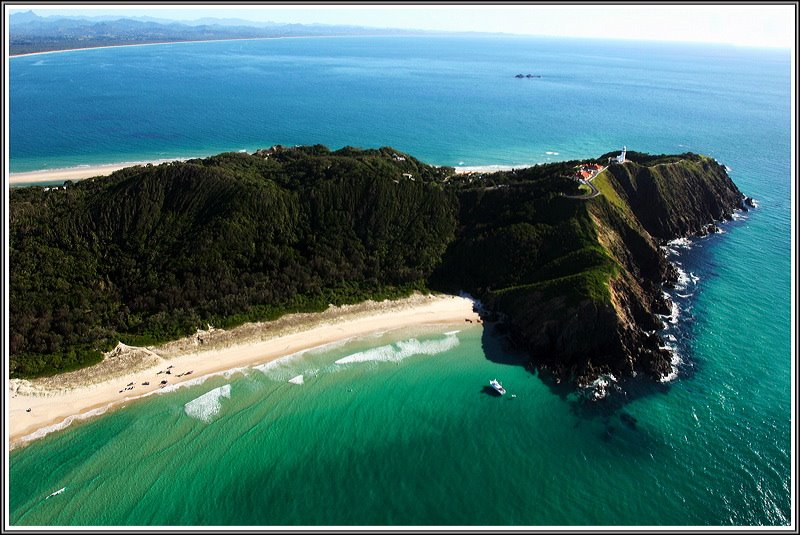
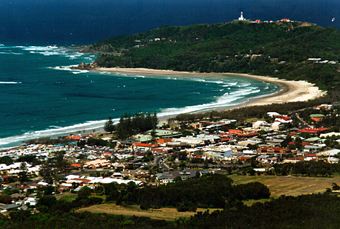
I can see why Captain Cook was pretty excited about the Easternmost part of this continent!
I just got back to Sydney after visiting Byron Bay, the Marin County of Australia. Just imagine Malibu or Stinson with a population density closer to New Zealand's south island.
It was heavenly! (photos copyright echo.net.au)
I was there to visit writer Jane Camens, who's got a house set unbelievably between a jungle thicket of rubber trees and bottle brush trees AND the vast powdery stretch of Tallow Beach!
I mean, I love my occasional dawn stroll down Seminyak's hard packed strand, but to walk with Jane and Harry and Sasha the Viszla.. in the company of -what?- twenty other people on a five mile beach... well, it was mind bending!
I will write a little more, later on...
Tuesday, August 22, 2006
Still in Love After 27 Years
Well, August 18 was my wedding anniversary.
The doctor who issued my blood test results for my marriage license in 1979 is probably dead, now, but I would like to give him a hearty "told ya so" for grumblingly chiding me for wanting to get married at the age of 20.
The man and I had been hosting our pals John and Lai Chee, up from Oz and down from S'pore, respectively. We were not about to let them leave us without one last snorkel. So off we went to the little cove at "Good Karma Bungalows" in Amed, where we had a greaaaat morning snorkel.
Back at the Shak we undressed like maniacs, showered quickly and took the obligatory photos of our group at the front gate. Then high tailed it to the airport for goodbyes.
It was time for lunch, so me and my husband of 27 years went to the little cafe of the Harris hotel in Tuban. Okay food, cute atmosphere, great restrooms. Then off to Uluwatu. We had not been back there since September of 1979! Some things never change: the topless girl on the beach. Some things do: concrete stairs down to the caves.
Just lovely to stand on the bukit and just watch the waves come in and watch guys catching them. We stood for a long time, just watching.
Uluwatu was a landmark. Lived here for 5 years and we still hadn't gone back there. I think we now have only three other spots in Bali to visit to completely revisit our honeymoon... the hot springs by the side of Lake Batur, Medewi beach, and the Sangeh temple full of monkeys. But Uluwatu gives you the magical feeling of being on the edge of Bali.
We have our own little tanjung at the Shak, but it is a different feeling. You feel like you are at the end of the world in Uluwatu. At our humble digs, the nearby islands and breaking waves across the land spit make you think that you are at a crossroads of forces, of sea routes, and winds. A convergence. Uluwatu is to surrender. TS is to participate. Both places magic, both held dear in our hearts.
Dinner at Hu'u, which would have been perfect if the bartender could fix me an "Angel Falls" at our table, and if the same jazz vocal CD wasn't playing over and over... But it was a good celebratory dinner. Great atmosphere, even with the odd jet airplane zooming overhead. Actually, that was pretty cool. I'd say it was an awesome day.
The doctor who issued my blood test results for my marriage license in 1979 is probably dead, now, but I would like to give him a hearty "told ya so" for grumblingly chiding me for wanting to get married at the age of 20.
The man and I had been hosting our pals John and Lai Chee, up from Oz and down from S'pore, respectively. We were not about to let them leave us without one last snorkel. So off we went to the little cove at "Good Karma Bungalows" in Amed, where we had a greaaaat morning snorkel.
Back at the Shak we undressed like maniacs, showered quickly and took the obligatory photos of our group at the front gate. Then high tailed it to the airport for goodbyes.
It was time for lunch, so me and my husband of 27 years went to the little cafe of the Harris hotel in Tuban. Okay food, cute atmosphere, great restrooms. Then off to Uluwatu. We had not been back there since September of 1979! Some things never change: the topless girl on the beach. Some things do: concrete stairs down to the caves.
Just lovely to stand on the bukit and just watch the waves come in and watch guys catching them. We stood for a long time, just watching.
Uluwatu was a landmark. Lived here for 5 years and we still hadn't gone back there. I think we now have only three other spots in Bali to visit to completely revisit our honeymoon... the hot springs by the side of Lake Batur, Medewi beach, and the Sangeh temple full of monkeys. But Uluwatu gives you the magical feeling of being on the edge of Bali.
We have our own little tanjung at the Shak, but it is a different feeling. You feel like you are at the end of the world in Uluwatu. At our humble digs, the nearby islands and breaking waves across the land spit make you think that you are at a crossroads of forces, of sea routes, and winds. A convergence. Uluwatu is to surrender. TS is to participate. Both places magic, both held dear in our hearts.
Dinner at Hu'u, which would have been perfect if the bartender could fix me an "Angel Falls" at our table, and if the same jazz vocal CD wasn't playing over and over... But it was a good celebratory dinner. Great atmosphere, even with the odd jet airplane zooming overhead. Actually, that was pretty cool. I'd say it was an awesome day.
Tuesday, August 08, 2006
North Capitol
Beijing, baby! Smog, massive buildings, ring roads, pepper trees, everything grey dust gloriously interrupted by Yves Klein blue in a worker's uniform.
Just got back from the 798 Artists Space, which has expanded into a small city. Drooled over Hao Guang's stacks of old found pots, enjoyed his 799 Gallery, but best of all got to meet the man at work in his studio on an image of himself with a dog. He spoke to me in French, I spoke back in English.
Coup of the day was picking up a signed copy of Sheng Qi's Madness Appropriation. I mean, unfortunately, the whole area is overrun with cultural revolution imagery. When will this crap stop being chic? Sheng Qi, at least, is dealing with truth and pain. I loved that his gallery had not a closed or open sign, but a censored sign.
Just got back from the 798 Artists Space, which has expanded into a small city. Drooled over Hao Guang's stacks of old found pots, enjoyed his 799 Gallery, but best of all got to meet the man at work in his studio on an image of himself with a dog. He spoke to me in French, I spoke back in English.
Coup of the day was picking up a signed copy of Sheng Qi's Madness Appropriation. I mean, unfortunately, the whole area is overrun with cultural revolution imagery. When will this crap stop being chic? Sheng Qi, at least, is dealing with truth and pain. I loved that his gallery had not a closed or open sign, but a censored sign.
Thursday, August 03, 2006
Typhoon Prapiroon Skims Hong Kong
... and don't we just love the clean air!
Wandering out this morning inadvertantly was a nostalgic trip down memory lane. The aftermath of any storm is always interesting, but a typhoon is almost a kind of ecstasy.
Ah, that was why I loved Hong Kong... the gardeners walking around in coolie hats and rubber boots... and a wife beater shirt and striped shorts... straight outta Lily Wong comics.
Thankfully no torrential rain like yesterday, but I suffered from out-of-shape legs... Jeeeez, did I really do that much walking when I lived here? Well, yes, I did. Bali life is so tame compared to all this. You know what they say about Bali Belly? The gastrointestinal ailment, usually a kind of food poisoning? Well, the real Bali Belly is the two or five or ten extra inches that the expat gets when he or she moves to the easy life of Bali. No exertion, no walking, and all the drinking, eating, and smoking that you can handle.
So I went to apply for the India visa (Mrs Gupta told me to get there to apply at 9 am, but those of us queuing at the Visa window were treated to a procession of Consular staff who began trickling in at 9:12 and were still sauntering in, in dribs and drabs, by 9:43, when I was handed my claim slip). Gupta herself didn't get there until 9:20, and I assumed she was needed in the back for pre-work chanting or to hear the "bureaocratic boost of the day." But when she emerged at 9:32, she began paper shuffling operations. Woops, forgot the receipt book. Back in three minutes. Maddening stuff.
Back in the hotel, my man says we can stay another night, that going to Macau is not really necessary, that he can make it a day trip. My dogs (Yankee slang) say, "yes, yes, stay Hong Kong." Here in our aerie above the harbor, all is wonderful.
The shopping list dwindles as I pick up Cuprinol, progest cream, all those amazing things not available in the land of begging to the Gods.
Wandering out this morning inadvertantly was a nostalgic trip down memory lane. The aftermath of any storm is always interesting, but a typhoon is almost a kind of ecstasy.
Ah, that was why I loved Hong Kong... the gardeners walking around in coolie hats and rubber boots... and a wife beater shirt and striped shorts... straight outta Lily Wong comics.
Thankfully no torrential rain like yesterday, but I suffered from out-of-shape legs... Jeeeez, did I really do that much walking when I lived here? Well, yes, I did. Bali life is so tame compared to all this. You know what they say about Bali Belly? The gastrointestinal ailment, usually a kind of food poisoning? Well, the real Bali Belly is the two or five or ten extra inches that the expat gets when he or she moves to the easy life of Bali. No exertion, no walking, and all the drinking, eating, and smoking that you can handle.
So I went to apply for the India visa (Mrs Gupta told me to get there to apply at 9 am, but those of us queuing at the Visa window were treated to a procession of Consular staff who began trickling in at 9:12 and were still sauntering in, in dribs and drabs, by 9:43, when I was handed my claim slip). Gupta herself didn't get there until 9:20, and I assumed she was needed in the back for pre-work chanting or to hear the "bureaocratic boost of the day." But when she emerged at 9:32, she began paper shuffling operations. Woops, forgot the receipt book. Back in three minutes. Maddening stuff.
Back in the hotel, my man says we can stay another night, that going to Macau is not really necessary, that he can make it a day trip. My dogs (Yankee slang) say, "yes, yes, stay Hong Kong." Here in our aerie above the harbor, all is wonderful.
The shopping list dwindles as I pick up Cuprinol, progest cream, all those amazing things not available in the land of begging to the Gods.
Monday, July 31, 2006
Seraya Fast Lane
Sometimes I miss Hong Kong. The buzz, the cool stuff to see and do, the nearly year-round hiking, finding old pots in village rubbish heaps, swimming laps in the big pool, walking, walking, cheongsams, tailors, ferries, friends, exhibitions at John Batten gallery, basso profundo frog talk on rainy nights, Singapore noodles, ten dollar wonton soup, Freddy, big rocks sticking out of hillsides, dancing to a good band at the Wanch, the skyline, grabbing a drink with friends before heading out to a movie or concert.
I just had a lengthy couple of conversations with HKU prof Paul Smethurst. I took two of his courses at HKU, and, although I hate postmodernism, he made me really understand it. In fact, we probably don't even see eye to eye on any number of scholarly topics, but he never gave me a bad grade. A prof who's a teacher, not a politician. And that's pretty cool!
Paul gives me props for telling him, "you're not getting any younger" back in 2000, when I first bought the Bali land. This made some impact on him, for he followed on down to Bali and got himself a nice little villa north of Seminyak. He's got something going up in the mountains, now, too. Wow! Dude loves his real estate!
So it got me thinking, as I'm telling Paul all about how I miss HK. But I have to admit that Bali has its own buzz. It's just a mellower buzz.
I certainly do my share of entertaining, here in the Shack. I had a few good friends down to celebrate the fact that it's a short snort to points west and south, now, thanks to the new bypass. What was going to be my big blowout party ended up being a little dinner. Big party must come later, when my friends are not suffering from Morning Sickness, broken cars, and other regrets.
But, yeah, I give a party here and the band plays or the girls dance, or both. Sure as hell didn't do that in either of our tiny apartments in Hongkers.
While I miss some of the really good rock bands of the bars of HK, I do get to got to the Denpasar arts festival and hear fusion bands (what that means is a synth, guitar, and drum set backing gong kebyar... but it can be very cool). I may not be able to strut around in a form fitted cheongsam here in Bali, but I do get to wear some nice Javanese sarongs. Laps in the pool... hell yeah, and the pool is all to myself now. Okay, the walking and hiking... there's the rub. Near equatorial sun makes hiking difficult. Here in Bali, you pretty much have to choose a mountain area, dawn hours, or (rare) shaded paths. The Bugbug hill is suitable for afternoon hiking because of the shade, but I do neighborhood walks in the dawn.
Okay, now my life has all this new stuff in it: teaching my cook new dishes, recipes, menus; doing Buteyko breathing exercises to minimize my sinus problems, yelling at the TV news (Israeli army & politicians get my loudest insults), working on my novel (which will undoubtedly make me a small fortune in royalties), and cleaning up the clippings and piles of crap. Bonus time is devoted to helping the schools around here (latest project is getting Pusat Pendidikan Lingkunan Hidup out here to teach the kids the basics of environmental health). We gotta get in the basics, like trash management, English, and reading. So libraries are my other favorite project. I am also working on the girls in the village, one at a time, to stay in school and not just get pregnant at age 15. It is all slow going, but Seraya will benefit. I help the Ubud Writers Festival with promotional materials. That is great fun for readers here, when all of our writers come and dazzle us each October, but the not-so-hidden agenda is the Saraswati Foundation, which helps kids learn, and they benefit from the festival.
Basically I've moved on from getting my kids through school to getting other kids through school. The world is a delicate place and it's wonderful to see how working delicately moves mountains. Too many people are overwhelmed by poverty and cruelty, and they won't do even one thing.
More on that in a moment.
So nice to sit here on the computer and listen to my husband mix the tracks of the traditional and not-so-traditional music and chanting of Dewa Balian. It will be a lovely CD when it's done.
I just had a lengthy couple of conversations with HKU prof Paul Smethurst. I took two of his courses at HKU, and, although I hate postmodernism, he made me really understand it. In fact, we probably don't even see eye to eye on any number of scholarly topics, but he never gave me a bad grade. A prof who's a teacher, not a politician. And that's pretty cool!
Paul gives me props for telling him, "you're not getting any younger" back in 2000, when I first bought the Bali land. This made some impact on him, for he followed on down to Bali and got himself a nice little villa north of Seminyak. He's got something going up in the mountains, now, too. Wow! Dude loves his real estate!
So it got me thinking, as I'm telling Paul all about how I miss HK. But I have to admit that Bali has its own buzz. It's just a mellower buzz.
I certainly do my share of entertaining, here in the Shack. I had a few good friends down to celebrate the fact that it's a short snort to points west and south, now, thanks to the new bypass. What was going to be my big blowout party ended up being a little dinner. Big party must come later, when my friends are not suffering from Morning Sickness, broken cars, and other regrets.
But, yeah, I give a party here and the band plays or the girls dance, or both. Sure as hell didn't do that in either of our tiny apartments in Hongkers.
While I miss some of the really good rock bands of the bars of HK, I do get to got to the Denpasar arts festival and hear fusion bands (what that means is a synth, guitar, and drum set backing gong kebyar... but it can be very cool). I may not be able to strut around in a form fitted cheongsam here in Bali, but I do get to wear some nice Javanese sarongs. Laps in the pool... hell yeah, and the pool is all to myself now. Okay, the walking and hiking... there's the rub. Near equatorial sun makes hiking difficult. Here in Bali, you pretty much have to choose a mountain area, dawn hours, or (rare) shaded paths. The Bugbug hill is suitable for afternoon hiking because of the shade, but I do neighborhood walks in the dawn.
Okay, now my life has all this new stuff in it: teaching my cook new dishes, recipes, menus; doing Buteyko breathing exercises to minimize my sinus problems, yelling at the TV news (Israeli army & politicians get my loudest insults), working on my novel (which will undoubtedly make me a small fortune in royalties), and cleaning up the clippings and piles of crap. Bonus time is devoted to helping the schools around here (latest project is getting Pusat Pendidikan Lingkunan Hidup out here to teach the kids the basics of environmental health). We gotta get in the basics, like trash management, English, and reading. So libraries are my other favorite project. I am also working on the girls in the village, one at a time, to stay in school and not just get pregnant at age 15. It is all slow going, but Seraya will benefit. I help the Ubud Writers Festival with promotional materials. That is great fun for readers here, when all of our writers come and dazzle us each October, but the not-so-hidden agenda is the Saraswati Foundation, which helps kids learn, and they benefit from the festival.
Basically I've moved on from getting my kids through school to getting other kids through school. The world is a delicate place and it's wonderful to see how working delicately moves mountains. Too many people are overwhelmed by poverty and cruelty, and they won't do even one thing.
More on that in a moment.
So nice to sit here on the computer and listen to my husband mix the tracks of the traditional and not-so-traditional music and chanting of Dewa Balian. It will be a lovely CD when it's done.
Saturday, July 29, 2006
Happy Birthday, David M!
Okay, so this is my bro's 50th birthday. Leo Monkey... hmmm.
Davy is 50 and will be having a big party. Sorry to be missing it. We are on an austerity program and I won't be taking any extraneous trips for a while.
Davy has a BS from UC Santa Cruz in Natural History, one of the most time-consuming undergrad degrees around! He is a contractor in Oakland, CA, Master Builders. Save your jokes. We've already heard it.
I will next see my bro in New Delhi in October. Actually, I will see him on the flight from Singapore to Delhi. We will be met by The Original Binski, who is there learning Hindi and salting leeches from off of friends' legs. Check out her blog for more on that.
Then we catch up with Jim and Jay and all head for West Bengal and Darjeeling. I plan to toss the last little bits of my mom's ashes over along Observatory Hill, looking at Kanchenjunga. I am going to be glad to be rid of her ashes, because as long as they are in my possession, I am not letting her be her own being, on her own, a spirit and not a body. So there is a closure in going to Darj, a release of my mom's carnate self.
Davy is 50 and will be having a big party. Sorry to be missing it. We are on an austerity program and I won't be taking any extraneous trips for a while.
Davy has a BS from UC Santa Cruz in Natural History, one of the most time-consuming undergrad degrees around! He is a contractor in Oakland, CA, Master Builders. Save your jokes. We've already heard it.
I will next see my bro in New Delhi in October. Actually, I will see him on the flight from Singapore to Delhi. We will be met by The Original Binski, who is there learning Hindi and salting leeches from off of friends' legs. Check out her blog for more on that.
Then we catch up with Jim and Jay and all head for West Bengal and Darjeeling. I plan to toss the last little bits of my mom's ashes over along Observatory Hill, looking at Kanchenjunga. I am going to be glad to be rid of her ashes, because as long as they are in my possession, I am not letting her be her own being, on her own, a spirit and not a body. So there is a closure in going to Darj, a release of my mom's carnate self.
Friday, July 28, 2006
What I wrote about William Dalrymple for the Bali Advertiser:
Imagine this. Pursuing a career abroad, an Englishman comes to an Asian kingdom and is changed forever. The lifestyle, the warm weather, the color, the food, the unexpected delights win him over. He falls in love with a dark-tressed woman of graceful beauty. He changes his religion. He dresses like a native and adopts their manners and customs. He swears he’ll never go back.
Sounds like someone you know?
Not just another expat saga, it’s also the framework of a fascinating, true story of love, betrayal, and intrigue in colonial India: White Mughals by William Dalrymple, one of the writers par excellence who will grace Ubud at festival time.
Dalrymple first earned international accolades at the age of 22 with his richly evocative In Xanadu. His City of Jinns won him the 1994 Thomas Cook Travel Book Award, and he wrote and presented two documentary series for the BBC, Stones of the Raj and Indian Journeys.
The writer’s meticulous research and passionate feelings for India meld perfectly to bring readers into realms hitherto buried and forgotten. For White Mughals, Dalrymple drew from collections of correspondence (some in cypher) and massive piles of colonial records to synthesize history into a well-paced and nicely illustrated narrative novel. Set in a seductive world of mango orchards, carrot halwa, medicinal opium, remote forts, and boy servants, the intrigue and adversities of 18th century colonial India come alive in the hands of the reader.
White Mughals satisfies the interest of anyone who seeks to learn something of the era of Colonial Residents, cantonments, and Anglo-Indian gentleman poets. The level of detail in Dalrymple’s writing never mires the pace and flow of the book. Even his footnotes are fascinating and quite colorful, whether it is a two hundred year old description of mosquitos torturing the legs of guests under a dinner table, or accurate definitions of erotic yakshis and apsaras.
William Dalrymple will bring to the festival his rich knowledge of India’s past and present. His concentration on the country’s history and culture will nicely augment the words and views of our many invited writers from the subcontinent. Look for lively discussions, colorful readings, and the kind of magical serendipity for which the Ubud Writers Festival is becoming known.
Dalrymple enjoys his travels in India with a passion, lauding a street cook (whose simmering biryani is purportedly the best in Hydrabad) alongside his publishers’ names in the book’s acknowledgements. (Note to Festival Founder, gourmet restaurateur Janet deNeefe: so that’s why you love this chap)!
Also by William Dalrymple: From the Holy Mountain: A Journey in the Shadow of Byzantium and The Age of Kali: Indian Travels and Encounters.
Sounds like someone you know?
Not just another expat saga, it’s also the framework of a fascinating, true story of love, betrayal, and intrigue in colonial India: White Mughals by William Dalrymple, one of the writers par excellence who will grace Ubud at festival time.
Dalrymple first earned international accolades at the age of 22 with his richly evocative In Xanadu. His City of Jinns won him the 1994 Thomas Cook Travel Book Award, and he wrote and presented two documentary series for the BBC, Stones of the Raj and Indian Journeys.
The writer’s meticulous research and passionate feelings for India meld perfectly to bring readers into realms hitherto buried and forgotten. For White Mughals, Dalrymple drew from collections of correspondence (some in cypher) and massive piles of colonial records to synthesize history into a well-paced and nicely illustrated narrative novel. Set in a seductive world of mango orchards, carrot halwa, medicinal opium, remote forts, and boy servants, the intrigue and adversities of 18th century colonial India come alive in the hands of the reader.
White Mughals satisfies the interest of anyone who seeks to learn something of the era of Colonial Residents, cantonments, and Anglo-Indian gentleman poets. The level of detail in Dalrymple’s writing never mires the pace and flow of the book. Even his footnotes are fascinating and quite colorful, whether it is a two hundred year old description of mosquitos torturing the legs of guests under a dinner table, or accurate definitions of erotic yakshis and apsaras.
William Dalrymple will bring to the festival his rich knowledge of India’s past and present. His concentration on the country’s history and culture will nicely augment the words and views of our many invited writers from the subcontinent. Look for lively discussions, colorful readings, and the kind of magical serendipity for which the Ubud Writers Festival is becoming known.
Dalrymple enjoys his travels in India with a passion, lauding a street cook (whose simmering biryani is purportedly the best in Hydrabad) alongside his publishers’ names in the book’s acknowledgements. (Note to Festival Founder, gourmet restaurateur Janet deNeefe: so that’s why you love this chap)!
Also by William Dalrymple: From the Holy Mountain: A Journey in the Shadow of Byzantium and The Age of Kali: Indian Travels and Encounters.
Monday, July 03, 2006
Anita Desai

Here's what I've written and submitted to the Bali Adverstiser, in the regular column on the Ubud Writers Festival 2006:
Acclaimed author Anita Desai is guaranteed to add fuel to our theme Desa-Kala-Patra. Throughout her novels, short stories and children’s literature, Desai often focuses on the dilemma of identity and family relationships often in context with India’s recent social changes. Desai has received numerous literary awards and her work is touted by English professors from Princeton to the University of Hong Kong.
A sensitive heart and a bold hand synchronize in Desai’s work, giving the reader immensely rich reading experiences. Her created characters linger on in the mind, sculpted with substance, even in her shortest short stories. To read Desai is not to be overwhelmed in flowery descriptions, but to be allowed to observe salient moments of revelation and transformation. Preferring to reveal truth over sentimentality, Desai isolates the details that matter, with critics and admirers comparing her to some of the best modernist writers, including Virginia Woolf and T. S. Eliot.
Desai’s subjects are often seen captive in the walls of the home, or in a confining social convention, but she lets the reader see their hopes, pleasures, and compassions. Never claustrophobic, Desai’s characters’ domains and inner selves are given distinction and quiet dignity amidst an unyielding world. A tale about a going-away party, in her delightful Games at Twilight and Other Stories, to which many an expat can relate, is full of water metaphors to show a queasy sense of instability.
Having an affinity for both India and the west, Desai has a true familiarity with marginalization and dual ethnicity. Her mother was German, but adapted easily to life in India. The biggest difference between Desai’s parents and those in her neighborhood is that she and her sisters were encouraged to read the best English literature. Even as a 6 year old, she knew she would become a writer. Today, when she teaches creative writing, whether it be in New York or Cambridge, Desai emphasizes practice, in the same way that a musician must practice. But she also encourages reading itself.
Indian society is a popular subject matter today, and there are seemingly countless hot subcontinental writers. What really sets Desai apart is her deft use of language and ease with creating characters which ring true. Her writing is a popular scholarly subject, with just as many books about her work as books authored by her.
We’ll never see her work distinguished in the UK’s annual “bad sex in fiction” literary stakes (Salman Rushdie and Arundhati Roy have had that dubious honor). Desai has been shortlisted for the Booker Prize three times and can count Rushdie himself amongst her many fans.
Suggested pre-Festival reading from Desai: Games at Twilight and Other Stories, Clear Light of Day, Baumgartner’s Bombay, and Fasting, Feasting. Desai adapted her novel In Custody for the screen in the Merchant-Ivory production of Hifazaat; possibly can be found on DVD, but don’t bring a pirate copy to the book signing! A Festival lunch with Desai will be a sure sellout this October.
Sunday, July 02, 2006
What Joe Lavin Wrote, December 30, 2003
I just love to read bad sex scenes. The Brits have a great award for it, not that there's a prize or anything. Salman Rushdie and Arundhati Roy have been chosen in past years... what's the deal with Indian writers and bad love scenes???
I quote from Lavin's website:
At any rate, 'tis the season for wacky end-of-the-year awards. One of the most famous, the Bad Sex in Literature Award, was recently presented in London. Each year, Literary Review gives this award for the worst description of sex in a novel. Aniruddha Bahal won this year's prize for his novel "Bunker 13," which featured this stunning passage:
"Your RPM is hitting a new high. To wait any longer would be to lose prime time... She picks up a Bugatti's momentum. You want her more at a Volkswagen's steady trot. Squeeze the maximum mileage out of your gallon of gas. But she's eating up the road with all cylinders blazing. You lift her out. You want to try different kinds of fusion."
Interestingly enough, Bahal was also a finalist for the Bad Automotive Reviews in Literature Award, an equally prestigious though oft-ignored prize. Another passage contains this bewildering line: "Her breasts are placards for the endomorphically endowed." I don't even know what that means, but I bet it's got all those people over at yourdictionary.com really turned on.
http://joelavin.com/awards.html
I quote from Lavin's website:
At any rate, 'tis the season for wacky end-of-the-year awards. One of the most famous, the Bad Sex in Literature Award, was recently presented in London. Each year, Literary Review gives this award for the worst description of sex in a novel. Aniruddha Bahal won this year's prize for his novel "Bunker 13," which featured this stunning passage:
"Your RPM is hitting a new high. To wait any longer would be to lose prime time... She picks up a Bugatti's momentum. You want her more at a Volkswagen's steady trot. Squeeze the maximum mileage out of your gallon of gas. But she's eating up the road with all cylinders blazing. You lift her out. You want to try different kinds of fusion."
Interestingly enough, Bahal was also a finalist for the Bad Automotive Reviews in Literature Award, an equally prestigious though oft-ignored prize. Another passage contains this bewildering line: "Her breasts are placards for the endomorphically endowed." I don't even know what that means, but I bet it's got all those people over at yourdictionary.com really turned on.
http://joelavin.com/awards.html
Sunday, June 18, 2006
Don't Know Why... There's No Sun Up in the Sky...
Don't know why
There's no sun up in the sky
Stormy weather
Since my man and I ain't together
Keeps rainin' all of the time
Life is bare
Gloom and misery everywhere
Stormy weather
Just can't get my poor self together
I'm weary all the time
So weary all of the time
Since you went away
The blues stepped in and met me
If it's here to stay
Old rocking chair will get me
Every night I pray
That the Lord above will let me
Walk in the sun once more
by Ted Koehler and Harold Arlen
What the hell is going on with the weather here in Seraya!?
It is supposed to be the dry season, and instead we are getting rain, rain, rain.
It is great for my garden, but I suspect Al Gore is on to something in his global warming lecture series and popular flick.
There's no sun up in the sky
Stormy weather
Since my man and I ain't together
Keeps rainin' all of the time
Life is bare
Gloom and misery everywhere
Stormy weather
Just can't get my poor self together
I'm weary all the time
So weary all of the time
Since you went away
The blues stepped in and met me
If it's here to stay
Old rocking chair will get me
Every night I pray
That the Lord above will let me
Walk in the sun once more
by Ted Koehler and Harold Arlen
What the hell is going on with the weather here in Seraya!?
It is supposed to be the dry season, and instead we are getting rain, rain, rain.
It is great for my garden, but I suspect Al Gore is on to something in his global warming lecture series and popular flick.
Diana Darling: Bali's Jane Austen
Preview of upcoming Bali Advertiser article...
Is it possible that we have a Jane Austen in our midst? Believe it! Diana Darling’s The Painted Alphabet, based on a Balinese tale, reveals a similarly luscious talent and a sharp eye for human intrigue. Using graceful economy and incisive wit, Austen and Darling are master novelists, joyfully exploiting the vagaries of human relationships, in a format that ends with all loose ends ever so neatly tied up. Enak!
Ubud’s Darling was part of the influx of hippies and artists who sought in Bali not just an alternate lifestyle but an alternate universe. The mystical culture of Bali has great appeal, but to some seekers, like Diana, it held the promise of discovering the unseen.
“We were temple-mad… scouting the island for good temple festivals… [meaning] that it had dancing or trance; otherwise there was no point in going. …I longed to go into a trance,” Darling writes in Bali Kini, 1998.
Although she owns up to having once been “the most ridiculous, obnoxiously pedantic Baliphiliac on the island,” her explorations have rewarded her. Today she exudes an air of wisdom and good humor, in her writing and in life. She’s sensitive to village ways, more than happy to live in a Balinese household, and counts Balinese elders as some of her greatest teachers.
Her first novel, The Painted Alphabet, named a “treasure” by Periplus, and “dazzling” by The New Yorker, deserves top honors in the plethora of books penned by those smitten with the island of the gods. A thrilling story of love, loss, sorcery, and triumph, Darling gently binds the reader in a spell using precise pacing, humorous and evocative descriptions, and an assured knowledge of Balinese tradition.
A strong thread of Hindu dharma is laced through the novel, especially the formula for propriety which is this year’s festival theme: Desa, Kala, Patra, the belief that identity is informed by circumstance. Perhaps the book could be described succinctly as a lesson for accepting change.
She’s got a second novel in the works, which she calls “a fictional account dealing with the history of tourism in Bali,” and, perhaps most exciting of all, she’s writing the libretto for an opera based on The Painted Alphabet. Bali is eminently suited to multidisciplinary creations. Some of the most memorable moments of the past two Ubud Writers Festivals were performances of songs and theatre.
“I’ve always wanted to see The Painted Alphabet as an opera,” Darling wrote to this reporter. “A friend of mine recently suggested that we develop it as a theatrical piece. I saw a lot of music in it, and finally the penny dropped: make it all music. The dialogue is necessarily very concentrated. It’s reduced to its lyrical essentials, which is a way I like to work.
“I envision a musical style that is very much its own and that delivers the requirements of the story and the verse in which it’s composed. Because the setting is Bali, we want certain Balinese musical elements, but not straightforward gamelan either. It will be very eclectic.
“As for the writing process, the idea is to think in songs, not in narrative. You have to find the emotional pitch of the moment that requires that this particular dialogue MUST be sung. There is room to indicate stage directions as well, and I have quite specific ideas of things I’d like to see in the production. There will be some use of film in different styles. But all this is in a fantasy stage right now: that is, getting the fantasy down on paper.
‘My understanding is that the libretto is the architectural structure on which the composer builds the music. No, we haven’t begun looking for a composer. I want to finish the libretto first, or at least have a complete draft, before presenting it to a composer. That’s only fair. Then of course I would like us to collaborate closely.”
Not without a touch of irony, Darling says that “my only requirement of the music is that it be exactly right and very beautiful.” Her stunning prose deserves no less.
Diana Darling was born in the USA in 1947, studying acting in New York and performing Off-Off-Broadway from 1970 to 1974. She lived in Carrera, Italy, carving marble (1974-80), and studied drawing in Paris (76-78). Moving to Bali in 1980, she soon married Australian filmmaker John Darling (until 1987) and is now married to A. A. Alit Ardi of Ubud. She’s been editor-in-chief for the highly praised Latitudes magazine, and has contributed essays to many publications on Bali style and culture. Alongside her personal works in progress, Darling has a day job as a copywriter.
Is it possible that we have a Jane Austen in our midst? Believe it! Diana Darling’s The Painted Alphabet, based on a Balinese tale, reveals a similarly luscious talent and a sharp eye for human intrigue. Using graceful economy and incisive wit, Austen and Darling are master novelists, joyfully exploiting the vagaries of human relationships, in a format that ends with all loose ends ever so neatly tied up. Enak!
Ubud’s Darling was part of the influx of hippies and artists who sought in Bali not just an alternate lifestyle but an alternate universe. The mystical culture of Bali has great appeal, but to some seekers, like Diana, it held the promise of discovering the unseen.
“We were temple-mad… scouting the island for good temple festivals… [meaning] that it had dancing or trance; otherwise there was no point in going. …I longed to go into a trance,” Darling writes in Bali Kini, 1998.
Although she owns up to having once been “the most ridiculous, obnoxiously pedantic Baliphiliac on the island,” her explorations have rewarded her. Today she exudes an air of wisdom and good humor, in her writing and in life. She’s sensitive to village ways, more than happy to live in a Balinese household, and counts Balinese elders as some of her greatest teachers.
Her first novel, The Painted Alphabet, named a “treasure” by Periplus, and “dazzling” by The New Yorker, deserves top honors in the plethora of books penned by those smitten with the island of the gods. A thrilling story of love, loss, sorcery, and triumph, Darling gently binds the reader in a spell using precise pacing, humorous and evocative descriptions, and an assured knowledge of Balinese tradition.
A strong thread of Hindu dharma is laced through the novel, especially the formula for propriety which is this year’s festival theme: Desa, Kala, Patra, the belief that identity is informed by circumstance. Perhaps the book could be described succinctly as a lesson for accepting change.
She’s got a second novel in the works, which she calls “a fictional account dealing with the history of tourism in Bali,” and, perhaps most exciting of all, she’s writing the libretto for an opera based on The Painted Alphabet. Bali is eminently suited to multidisciplinary creations. Some of the most memorable moments of the past two Ubud Writers Festivals were performances of songs and theatre.
“I’ve always wanted to see The Painted Alphabet as an opera,” Darling wrote to this reporter. “A friend of mine recently suggested that we develop it as a theatrical piece. I saw a lot of music in it, and finally the penny dropped: make it all music. The dialogue is necessarily very concentrated. It’s reduced to its lyrical essentials, which is a way I like to work.
“I envision a musical style that is very much its own and that delivers the requirements of the story and the verse in which it’s composed. Because the setting is Bali, we want certain Balinese musical elements, but not straightforward gamelan either. It will be very eclectic.
“As for the writing process, the idea is to think in songs, not in narrative. You have to find the emotional pitch of the moment that requires that this particular dialogue MUST be sung. There is room to indicate stage directions as well, and I have quite specific ideas of things I’d like to see in the production. There will be some use of film in different styles. But all this is in a fantasy stage right now: that is, getting the fantasy down on paper.
‘My understanding is that the libretto is the architectural structure on which the composer builds the music. No, we haven’t begun looking for a composer. I want to finish the libretto first, or at least have a complete draft, before presenting it to a composer. That’s only fair. Then of course I would like us to collaborate closely.”
Not without a touch of irony, Darling says that “my only requirement of the music is that it be exactly right and very beautiful.” Her stunning prose deserves no less.
Diana Darling was born in the USA in 1947, studying acting in New York and performing Off-Off-Broadway from 1970 to 1974. She lived in Carrera, Italy, carving marble (1974-80), and studied drawing in Paris (76-78). Moving to Bali in 1980, she soon married Australian filmmaker John Darling (until 1987) and is now married to A. A. Alit Ardi of Ubud. She’s been editor-in-chief for the highly praised Latitudes magazine, and has contributed essays to many publications on Bali style and culture. Alongside her personal works in progress, Darling has a day job as a copywriter.
Friday, June 16, 2006
Back in Bali
Picked up The Man at Ngurah Rai Airport and went to ...you guessed it... Makro! The raja of grocery stores here in the isle of gods and rajas.
Just checking in. No news to report, except that I ran into friends Sue and Peta in the space of 2 minutes (outside of Dijon, how terminally EXPAT is that?). I don't see anyone outside of Amlapura postal delivery men and the boys at the pool hall across the street. So it's mind boggling to see these gals in so short a time span.
Feel pretty good about recent interview with Diana Darling. She's a wonderful writer. It could be that Bali is a damn good environment for honing one's writing skills.
Also feel pretty good about short story sent to Nury of the Asian Literary Review (née Dimsum).
Watch the Bali Advertiser for the DD interview.
Just checking in. No news to report, except that I ran into friends Sue and Peta in the space of 2 minutes (outside of Dijon, how terminally EXPAT is that?). I don't see anyone outside of Amlapura postal delivery men and the boys at the pool hall across the street. So it's mind boggling to see these gals in so short a time span.
Feel pretty good about recent interview with Diana Darling. She's a wonderful writer. It could be that Bali is a damn good environment for honing one's writing skills.
Also feel pretty good about short story sent to Nury of the Asian Literary Review (née Dimsum).
Watch the Bali Advertiser for the DD interview.
Tuesday, June 06, 2006
666
666
I wish I had some checks to sign, or more letters to write. I am unwilling to waste this amazing date!
I am stuck at the internet cafe in Amlapura, sharing a dialup line with three other people, trying to get in this blog before it's time to go home to lunch.
Ariel and Kim and I arrived in Bali late last night. A successful operation all around, with no confiscated items by homeland security airport thugs.
Bali had the cutest black lab sniffer dog give all my bags a big wagging once-over, and it's a good thing they train those doggies to detect cocaine and marijuana, because if they ever get one of those guys to sniff out furniture polish, I'm dead.
Odd weather lately in East Bali, with rain clouds whirling overhead, patches of intense blue in between. I mean, is this June or January? Wet deck in the morning tells me our global weather is messed up this year.
Okay, eager to plan the next few days with the girls. I'll make the suggestions and they'll have to decide when to do what. On their list: rafting, surfing, and a visit to M Bar Go because Georgina Barnett is the PR girl there.
Spotted a very cool deal from the Hyatt here, where two nights cost only 988,000 Rupiah. Ariel and Kim are considering taking that on.
Horrid dialup situation keeps me disjointed and boring. Sorry. On 6/6/6, I am boring.
I wish I had some checks to sign, or more letters to write. I am unwilling to waste this amazing date!
I am stuck at the internet cafe in Amlapura, sharing a dialup line with three other people, trying to get in this blog before it's time to go home to lunch.
Ariel and Kim and I arrived in Bali late last night. A successful operation all around, with no confiscated items by homeland security airport thugs.
Bali had the cutest black lab sniffer dog give all my bags a big wagging once-over, and it's a good thing they train those doggies to detect cocaine and marijuana, because if they ever get one of those guys to sniff out furniture polish, I'm dead.
Odd weather lately in East Bali, with rain clouds whirling overhead, patches of intense blue in between. I mean, is this June or January? Wet deck in the morning tells me our global weather is messed up this year.
Okay, eager to plan the next few days with the girls. I'll make the suggestions and they'll have to decide when to do what. On their list: rafting, surfing, and a visit to M Bar Go because Georgina Barnett is the PR girl there.
Spotted a very cool deal from the Hyatt here, where two nights cost only 988,000 Rupiah. Ariel and Kim are considering taking that on.
Horrid dialup situation keeps me disjointed and boring. Sorry. On 6/6/6, I am boring.
Sunday, June 04, 2006
Tienanmen Square 06
Without benefit of Cantonese ability, I can report only that the candlelight vigil was unreasonably short tonight. In previous years, I have left Victoria Park long before the commemoration was over.
Yet, it was still moving, with thousands of Hong Kong people, from all walks of life, humbly sitting on asphalt with their candles held high, singing songs of their passionate remembrance for the democracy demonstrators.
In the end, a Falun Dafa adherant spoke with me and my daughter and her friend, as hordes of people filed out of the park, telling us that HK people are under constant surveilance by the government in Beijing. Was this the reason the event broke up at 10 pm? I don't know.
More later. Must sleep.
Yet, it was still moving, with thousands of Hong Kong people, from all walks of life, humbly sitting on asphalt with their candles held high, singing songs of their passionate remembrance for the democracy demonstrators.
In the end, a Falun Dafa adherant spoke with me and my daughter and her friend, as hordes of people filed out of the park, telling us that HK people are under constant surveilance by the government in Beijing. Was this the reason the event broke up at 10 pm? I don't know.
More later. Must sleep.
Tien An Men Square Commemorative Guilt

Aiya!
Yesterday from 8 to 10 I was online doing a United Airlines survey while a number of artists were at ParaSite in an art performance in remembrance of the massacre at Tienanmen Square.
The extenuating circumstance was that I'd failed to read HK Magazine's calendar. Naturally, I read it this morning over a cup of Java.
Okay, today I vow to get to exit D of the Causeway Bay MTR station to see another perf on the streets. Will bring camera.
HK Live 2006
Got back just now from the Fringe... HK LIVE event, Channel V showcasing 3 local talents.
Fun pop band "Maladjusted" at first, 5 Chinese youngsters that sound like Oasis without attitude. Actually pretty enjoyable. Next band "Vibration" funkier and dancier and canto popier (rhymes with copier) with girl singer (singing spotty but stage presence cute & cheerful) and plenty of sampling & effects.
Final band "Robot," tonight encarnated as a quintet of cool nerds, mostly white, including two intense bald guy types, with a couple of tables of mixed electronics. Worth the price of admission was their 5 part film on evolution, filmed in HK and definitely inspired by bellbottom science (Open Learning, for readers who are not members of my family).
Robot would screen a part of the video and then pause it and play a tune (that electronic dance stuff for which boomers like me haven't quite developed a taste) and then go back to another section of the movie... hilarious sequence of cave men days filmed atop a typical hk rock outcropping, with massive HK urban highrise background.
Came home smelling like an ashtray (HK lags behind Oklahoma City and New Jersey, do you believe it?) and curious to know if I can fall asleep.
Fun pop band "Maladjusted" at first, 5 Chinese youngsters that sound like Oasis without attitude. Actually pretty enjoyable. Next band "Vibration" funkier and dancier and canto popier (rhymes with copier) with girl singer (singing spotty but stage presence cute & cheerful) and plenty of sampling & effects.
Final band "Robot," tonight encarnated as a quintet of cool nerds, mostly white, including two intense bald guy types, with a couple of tables of mixed electronics. Worth the price of admission was their 5 part film on evolution, filmed in HK and definitely inspired by bellbottom science (Open Learning, for readers who are not members of my family).
Robot would screen a part of the video and then pause it and play a tune (that electronic dance stuff for which boomers like me haven't quite developed a taste) and then go back to another section of the movie... hilarious sequence of cave men days filmed atop a typical hk rock outcropping, with massive HK urban highrise background.
Came home smelling like an ashtray (HK lags behind Oklahoma City and New Jersey, do you believe it?) and curious to know if I can fall asleep.
Saturday, June 03, 2006
The Forgotten Language
I emailed this to my son, who's fluent in Putonghua and can hold his own in hockey rink Cantonese:
Humbled in Honkers:
I flag a taxi, I jump in, expelling "Tai Hang Douh" as quickly as possible, for it's usually when ya go too slow that expat Cantonese doesn't cut it. I follow with "Wong Fung Toi", simply because Wong Fung Terrace is the little private road that I really mean, but I want him to get to Tai Hang Douh first.
"Wong Fung Toi?" driver intones back at me, genuinely puzzled, tapping the break in the middle of Lower Albert Road. He makes as if to go down Ice House Street, a true disaster.
"Wong Fung Toi, yes," I say. He's said it just like I did, and I am pretty darn sure I said it right.
Back and forth we verify and confirm and act like parrots, and I desperately add, So Kon Po, and he's all ahhhh! So Kon Po! and I think s**t, no, I don't want him to take me to So Kon Po... what the hell is Cantonese for "above?" And my mind spits out beautiful Indonesian sentences for perfectly explaining what he's gotta do.
"M'hai So Kon Po," I tsk, exasperatedly. I hope to God that I look like I am searching for a better way to explain myself, but how do you say in Cantonese, "I beg your pardon, but it seems to me that my Cantonese, formerly quite adequate for giving a taxi driver directions, is now virtually forgotten, replaced instead by halfway decent Indonesian?"
I sputter and pray he doesn't turn up towards Midlevels, as we are now racing along the underside of Government House towards Cotton Tree Drive.
He goes to his cell phone and speaks to dispatcher/wife/gambling buddy/random number: "gonggingjungmanggongwongdong Wong Fung Toi, ah?"
pause.
"Aaaaaaahhhhhh! WONG FUNG TOI !!!!" What's Eureka! in Chinese?
He hangs up with a smile and says to me, and I swear to God there is no difference between the two pronounciations, "M'hai Wong Fung Toi. WONG FUNG TOI ahhh" in a helpful, not at all insulting voice. Although I proffer a sincere, "duih m'jih", I'm thinking what the Sam Hill am I going to do next time I'm in a taxi and I want to get to Quentin's house? Taxi driver is chuckling to himself in that head shaking manner of "now I've heard everything! Wait'll the wife/drinking buddy/guys at the shop/ kids/dog hears THIS one!"
Readers, please do NOT tell me that wong fung toi, if intoned in a certain way, means "s**t my pants" or "swim with donkey" or worse. Then again, tell me how that would be pronounced so that I will never make that mistake again!
Humbled in Honkers:
I flag a taxi, I jump in, expelling "Tai Hang Douh" as quickly as possible, for it's usually when ya go too slow that expat Cantonese doesn't cut it. I follow with "Wong Fung Toi", simply because Wong Fung Terrace is the little private road that I really mean, but I want him to get to Tai Hang Douh first.
"Wong Fung Toi?" driver intones back at me, genuinely puzzled, tapping the break in the middle of Lower Albert Road. He makes as if to go down Ice House Street, a true disaster.
"Wong Fung Toi, yes," I say. He's said it just like I did, and I am pretty darn sure I said it right.
Back and forth we verify and confirm and act like parrots, and I desperately add, So Kon Po, and he's all ahhhh! So Kon Po! and I think s**t, no, I don't want him to take me to So Kon Po... what the hell is Cantonese for "above?" And my mind spits out beautiful Indonesian sentences for perfectly explaining what he's gotta do.
"M'hai So Kon Po," I tsk, exasperatedly. I hope to God that I look like I am searching for a better way to explain myself, but how do you say in Cantonese, "I beg your pardon, but it seems to me that my Cantonese, formerly quite adequate for giving a taxi driver directions, is now virtually forgotten, replaced instead by halfway decent Indonesian?"
I sputter and pray he doesn't turn up towards Midlevels, as we are now racing along the underside of Government House towards Cotton Tree Drive.
He goes to his cell phone and speaks to dispatcher/wife/gambling buddy/random number: "gonggingjungmanggongwongdong Wong Fung Toi, ah?"
pause.
"Aaaaaaahhhhhh! WONG FUNG TOI !!!!" What's Eureka! in Chinese?
He hangs up with a smile and says to me, and I swear to God there is no difference between the two pronounciations, "M'hai Wong Fung Toi. WONG FUNG TOI ahhh" in a helpful, not at all insulting voice. Although I proffer a sincere, "duih m'jih", I'm thinking what the Sam Hill am I going to do next time I'm in a taxi and I want to get to Quentin's house? Taxi driver is chuckling to himself in that head shaking manner of "now I've heard everything! Wait'll the wife/drinking buddy/guys at the shop/ kids/dog hears THIS one!"
Readers, please do NOT tell me that wong fung toi, if intoned in a certain way, means "s**t my pants" or "swim with donkey" or worse. Then again, tell me how that would be pronounced so that I will never make that mistake again!
Friday, June 02, 2006
Hong Kong: a stranger again
Well, it had to happen. I have been out of Honkers so long that I perceive all the things a stranger notices:
the dense crowds (and is EVERYONE 19 years old?)
the air conditioned interiors
the air
the gaga, overwhelmed faces of backpackers
the lack of good street signage
the relatively dressed-up appearance of young expats
the wrought iron bars on everyone's windows
concrete retaining walls with mortar blackened by mold and humidity
I checked into Susan and Q's nice trad HK flat (you know, one apartment per floor, no amenities, tiny kitchen, large lounge-dining area, surprisingly sizeable balcony). Hacked into the network (I think I'm not the only person on Q's line, it's a bit slow), and planned my stay. Had a couple hours in Causeway Bay, in search of a good adaptor (forgetting to pack one is another sign of a clueless stranger). Of course, along the way I bought eye makeup and yogurt. Tried to figure out the green minibus number that runs up along Tai Hang Road.
Got in, my calves aching from the walk! What walking I did, when I lived here.
the dense crowds (and is EVERYONE 19 years old?)
the air conditioned interiors
the air
the gaga, overwhelmed faces of backpackers
the lack of good street signage
the relatively dressed-up appearance of young expats
the wrought iron bars on everyone's windows
concrete retaining walls with mortar blackened by mold and humidity
I checked into Susan and Q's nice trad HK flat (you know, one apartment per floor, no amenities, tiny kitchen, large lounge-dining area, surprisingly sizeable balcony). Hacked into the network (I think I'm not the only person on Q's line, it's a bit slow), and planned my stay. Had a couple hours in Causeway Bay, in search of a good adaptor (forgetting to pack one is another sign of a clueless stranger). Of course, along the way I bought eye makeup and yogurt. Tried to figure out the green minibus number that runs up along Tai Hang Road.
Got in, my calves aching from the walk! What walking I did, when I lived here.
Friday, May 26, 2006
Ashes and Snow

Man, could some clever individual ever make a great parody of Gregory Colbert's Ashes and Snow.
Saw it on its last day at the Santa Monica Pier, as part of mega festivities for Grinch Girlfriend's Graduation.
I will suffer the slings and arrows of having an unpopular opinion, but I didn't really like the famous exhibition of beautiful native gals and kids cavorting with animals (most of them tamed).
Short critique: gorgeous cinematography elevates genre of pinup art.
Politically chic critique: 19th century glorification of the exotic "other" is alive and well in elephant-dung filled ponds where cafe-au-lait-skinned females cavort in exquisite slo-mo alongside gentle beasts.
Sorry... it was like visiting clown paintings on velvet, painted by David, where I would surely opine, "I bow to the grandmaster of schlock!"
Sunday, May 14, 2006
Saturday, May 06, 2006
Changi Airport: The Swimmer's Home Office
Hell, I post more stuff at this airport than any other place in the world. They have faster internet than what my cellphone - and - bamboo - pole - antenna setup gives me in Bali. They have utterly FREE connections, unlike casa verde in California. And I find myself standing in these air conditioned halls more often than any healthy person should.
So: the blog.
The news:
Successfully edited together Galapagos and Machu Picchu DVDs, so look out, all of you who requested same. Jay kept the time down to feature length movie... not baad, if you like Directors' Cuts!!
Won the first of this year's Ubud poetry slams. Too cool!
Note to self, and to Seminyak Business Dewas and Dewis Association: Jalan Dhyana Pura is looking like hell these days! The abandoned buildings which formerly housed small night clubs and boutiques are covered with trash. It brings down the atmosphere of the whole street. Please form a beautification committee or no one is going to want to stay at the Sofitel or eat at Gado Gado.
So: the blog.
The news:
Successfully edited together Galapagos and Machu Picchu DVDs, so look out, all of you who requested same. Jay kept the time down to feature length movie... not baad, if you like Directors' Cuts!!
Won the first of this year's Ubud poetry slams. Too cool!
Note to self, and to Seminyak Business Dewas and Dewis Association: Jalan Dhyana Pura is looking like hell these days! The abandoned buildings which formerly housed small night clubs and boutiques are covered with trash. It brings down the atmosphere of the whole street. Please form a beautification committee or no one is going to want to stay at the Sofitel or eat at Gado Gado.
Thursday, March 23, 2006
I Ain't Talkin' 'Bout Bolivia
You have to visit http://www.kissthisguy.com/ to understand the title to this post.
When a person such as myself is light-headed, strolling around at 8,000 feet, the mind does funny things. "I ain't talkin' bout Bolivia" runs through my head like a munching earwig out of a sci fi horror story.
How many times do we get the words wrong in a rock n roll song? The website above is devoted to this universal problem. You can look up the lyrics to a song and record your own mis-readings (or just read others' and have a good laugh).
Go to the website above and search "I'd Really Love to See you Tonight", where the lyrics can be found. I mistook the line, "I'm not talking about movin' in.." for "I'm not talkin bout Bolivia," but of course, that's just too preposterous for a love song, so I guessed (for years and years) that the right words were "I'm not talkin' bout believing ya". Then I went to this amusing website and realized that I had a double "mondegreen."
Anyway, someone named Betsy Gordon had the same misreading of the line.
bolivia... I'm not even THERE.
* * *
Which brings me to South America.
I just arrived in Quito, Ecuador, which looks modern and clean and green from the sky (in a landing reminiscent of Hong Kong's old Kai Tak Airport). But it is actually a little grotty around the edges, yet a chipper town with a fair mix of ethnic groups. The mountains are within view of my little desk at The Magic Bean, which is a kind of backpacker nexus in the Mariscal Sucre.
Jay and I got a little room here with private bath, and we look out over the lavanderia which is hopefully not destroying my 3 kilos of expensive North Face FIT wear.
Big welcome from the harried but capable Miguel Garcia, who got us booked on the Angelique sailing boat around the Galapagos next week. I have been inside only three buildings here, and I am already seeing a type of beautiful plank with large gaps between... definitely some sort of exotic hardwood.It seems that the traveler is drawn to these backpacker magnets like this 'hood, or the old town of Cuzco, Peru. I guess it takes some effort to get away from these places, because it is mighty convenient to stay there.
With Cuzco as our base, we trekked the Inca trail and soaked in Machu Picchu; then we trudged through mosquito-infested rain forest to see toucans and caymans in their natural habitat. In true backpacker fashion, we met up with Lai Chee and her traveling companion Bret. We looked like a thousand other moneyed gringo travelers who are playing explorer.
Winawayna is a not-to-be-missed Incan town on the outskirts of Machu Picchu. I can see why the prince made his holiday home at Machu Picchu, but if you want mystical magic, check out Winawayna. It is an agricultural settlement with tons of terraces stretching downwards in a funnel fashion on a mountainside. A couple of modest temple buildings are there, as is a priest's house. Homes for support folk are there, too, and it must not have been a huge town. But what a setting. Jagged mountains with permafrost are directly across from the settlement, giving the feeling that you are embraced by the security of the terraces and the mountain spurs but held aloft in the top of the world. It is impossible to sit there and not feel as if you are in the presence of majesty. And yet you are held warmly, like riding on the shoulders of an adult when you are a child.
When a person such as myself is light-headed, strolling around at 8,000 feet, the mind does funny things. "I ain't talkin' bout Bolivia" runs through my head like a munching earwig out of a sci fi horror story.
How many times do we get the words wrong in a rock n roll song? The website above is devoted to this universal problem. You can look up the lyrics to a song and record your own mis-readings (or just read others' and have a good laugh).
Go to the website above and search "I'd Really Love to See you Tonight", where the lyrics can be found. I mistook the line, "I'm not talking about movin' in.." for "I'm not talkin bout Bolivia," but of course, that's just too preposterous for a love song, so I guessed (for years and years) that the right words were "I'm not talkin' bout believing ya". Then I went to this amusing website and realized that I had a double "mondegreen."
Anyway, someone named Betsy Gordon had the same misreading of the line.
bolivia... I'm not even THERE.
* * *
Which brings me to South America.
I just arrived in Quito, Ecuador, which looks modern and clean and green from the sky (in a landing reminiscent of Hong Kong's old Kai Tak Airport). But it is actually a little grotty around the edges, yet a chipper town with a fair mix of ethnic groups. The mountains are within view of my little desk at The Magic Bean, which is a kind of backpacker nexus in the Mariscal Sucre.
Jay and I got a little room here with private bath, and we look out over the lavanderia which is hopefully not destroying my 3 kilos of expensive North Face FIT wear.
Big welcome from the harried but capable Miguel Garcia, who got us booked on the Angelique sailing boat around the Galapagos next week. I have been inside only three buildings here, and I am already seeing a type of beautiful plank with large gaps between... definitely some sort of exotic hardwood.It seems that the traveler is drawn to these backpacker magnets like this 'hood, or the old town of Cuzco, Peru. I guess it takes some effort to get away from these places, because it is mighty convenient to stay there.
With Cuzco as our base, we trekked the Inca trail and soaked in Machu Picchu; then we trudged through mosquito-infested rain forest to see toucans and caymans in their natural habitat. In true backpacker fashion, we met up with Lai Chee and her traveling companion Bret. We looked like a thousand other moneyed gringo travelers who are playing explorer.
Winawayna is a not-to-be-missed Incan town on the outskirts of Machu Picchu. I can see why the prince made his holiday home at Machu Picchu, but if you want mystical magic, check out Winawayna. It is an agricultural settlement with tons of terraces stretching downwards in a funnel fashion on a mountainside. A couple of modest temple buildings are there, as is a priest's house. Homes for support folk are there, too, and it must not have been a huge town. But what a setting. Jagged mountains with permafrost are directly across from the settlement, giving the feeling that you are embraced by the security of the terraces and the mountain spurs but held aloft in the top of the world. It is impossible to sit there and not feel as if you are in the presence of majesty. And yet you are held warmly, like riding on the shoulders of an adult when you are a child.
Tuesday, February 28, 2006
Giordano RULES!
Got to Macau to visit my hubby while he's here consulting to some big ol' slot machine company.
Macau weather still cold, and I knew I'd be back in northern California for a short time, so I thought I'd hit the clothing shops. First off, before I even get so far as the post office, I see one of those white-on-white clothing outlets that are so typical of Hong Kong and now, apparently, Macau. I go in and buy two bursting bags of ski jackets and fashion jackets and shirts and pants, some with the labels intact enough to know that I'm paying pennies on dollars. The whole haul is less than one hundred US dollars. All wonderful.
Probably the coolest thing, now that I've lived in Bali for 4 or 5 years, was that the prices were fair and marked indelibly on the tags. I mean, I haggled a little at the total, and I think the cashier knocked off MOP5 (I was paying in HKD, anyway, a nicer currency), but the main thing is, the haggling didn't DECIDE the sale.
Ladies of Bali Expatria, you tell me: ain't it a bitch to go into some cute little clothing shop, and there are no prices? It's the most popular Balinese dance: Shopping Joged. The steps are familiar to us all. You have to ask the nearest shopgirl for the price of every single item. You raise your eyebrows at the crappy first price. She counters by saying, but you can have a discount. You put one thing back, you pick up another. You repeat earlier steps. You hold the big pile of clothing and approach the cashier, asking for 50% of what you think you should be paying. She counters with a price that does not take into consideration the proffered discount by the first shop girl. You laugh gaily and point out the delightful mistake, being careful to say that 75% of what you want to pay is really more reasonable. They say no. Expert dancers at this point take out a calculator, and key in a slightly lower price for you to see. You say no, look to the door, offer 90% as a last price. They say no (boy, isn't this exciting?) and so you walk to the door, casually offering 100% of your own best price. They will either say yes or no, and if they say no, you better not go walking back in there unless you enjoy losing face. The end is the loss of your hard work choosing, calculating, and negotiating.
In Hong Kong and Macau, by contrast, each clothing shopper is on equal terms with the next. Maybe the shopkeeper's friends get a good deal every once in a while, but really there is a general equality amongst all punters. You go in, you see how much you gotta pay, you pay it, you leave. Surgical shopping.
Now, as I rounded into the beautiful plaza in the heart of downtown Macau, I spotted a Giordano shop. Giordano is a total Hong Kong phenom, beating American GAP to smithereens on several levels. Sometime back in the 60's, a delegation of Italian manufacturers came to Wanchai to show real style to Hong Kong people. Well, it convinced the Hong Kongers that Italian stuff is synonymous with style, but it also gave HK manufacturers a lot of great ideas. Giordano, Balino, and myriad other Italian-sounding style houses sprang up.
Giordano survived, with a difference. In about 1993, they decided that they would buck the trend of HK service and offer friendly salespeople, unlimited use of the dressing room, and dozens of available colors to choose from. No more "sorry out of stock", no more frowning girls ignoring your questions, no more exasperated sighs when you decide to not purchase an item, no more "you can't try on. Stretch fabric." Giordano suddenly became a frightening place for the jaded Hong Konger, for the barrage of smiles and hellos upon entry to the store. Tons of dressing rooms, girls searching earnestly through back rooms looking for extra stock... it was nothing we'd seen before. West of Hawaii, anyway.
But it stuck. To this day, Giordano is as ubiquitous in Hong Kong as Starbucks in urban America. And, true to form, as I entered the Macau Giordano, I was greeted by half a dozen young clerks, all smiling like Taiwanese or Samoans or Balinese or... anything but south Chinese!
I tried on twelve outfits, the girls helped me arrange shawls, they looked in the back for other sizes... it was quite a morning. Their help and suggestions and patience with me paid off for them. I laid down another hundred greenbacks. This time for several of their fabulous designs... the knit torquoise shrugs, the stretchy smooth long sleeve t shirts, a belt, shirts for my man, and probably would have bought more if I didn't already have a tonnage problem. Such great designs, such great fabrics, such unbeatable prices!
It dawned on me later that I had asked one of the salesgirls for something in pidgin Indonesian. She didn't even pout. She probably just figured I was German, struggling with the English language. Not that there isn't a German out there whose English is far superior to most American's.
Anyway, next stop for me was the luggage store. Had to buy a suitcase for all the loot.
But Giordano
Macau weather still cold, and I knew I'd be back in northern California for a short time, so I thought I'd hit the clothing shops. First off, before I even get so far as the post office, I see one of those white-on-white clothing outlets that are so typical of Hong Kong and now, apparently, Macau. I go in and buy two bursting bags of ski jackets and fashion jackets and shirts and pants, some with the labels intact enough to know that I'm paying pennies on dollars. The whole haul is less than one hundred US dollars. All wonderful.
Probably the coolest thing, now that I've lived in Bali for 4 or 5 years, was that the prices were fair and marked indelibly on the tags. I mean, I haggled a little at the total, and I think the cashier knocked off MOP5 (I was paying in HKD, anyway, a nicer currency), but the main thing is, the haggling didn't DECIDE the sale.
Ladies of Bali Expatria, you tell me: ain't it a bitch to go into some cute little clothing shop, and there are no prices? It's the most popular Balinese dance: Shopping Joged. The steps are familiar to us all. You have to ask the nearest shopgirl for the price of every single item. You raise your eyebrows at the crappy first price. She counters by saying, but you can have a discount. You put one thing back, you pick up another. You repeat earlier steps. You hold the big pile of clothing and approach the cashier, asking for 50% of what you think you should be paying. She counters with a price that does not take into consideration the proffered discount by the first shop girl. You laugh gaily and point out the delightful mistake, being careful to say that 75% of what you want to pay is really more reasonable. They say no. Expert dancers at this point take out a calculator, and key in a slightly lower price for you to see. You say no, look to the door, offer 90% as a last price. They say no (boy, isn't this exciting?) and so you walk to the door, casually offering 100% of your own best price. They will either say yes or no, and if they say no, you better not go walking back in there unless you enjoy losing face. The end is the loss of your hard work choosing, calculating, and negotiating.
In Hong Kong and Macau, by contrast, each clothing shopper is on equal terms with the next. Maybe the shopkeeper's friends get a good deal every once in a while, but really there is a general equality amongst all punters. You go in, you see how much you gotta pay, you pay it, you leave. Surgical shopping.
Now, as I rounded into the beautiful plaza in the heart of downtown Macau, I spotted a Giordano shop. Giordano is a total Hong Kong phenom, beating American GAP to smithereens on several levels. Sometime back in the 60's, a delegation of Italian manufacturers came to Wanchai to show real style to Hong Kong people. Well, it convinced the Hong Kongers that Italian stuff is synonymous with style, but it also gave HK manufacturers a lot of great ideas. Giordano, Balino, and myriad other Italian-sounding style houses sprang up.
Giordano survived, with a difference. In about 1993, they decided that they would buck the trend of HK service and offer friendly salespeople, unlimited use of the dressing room, and dozens of available colors to choose from. No more "sorry out of stock", no more frowning girls ignoring your questions, no more exasperated sighs when you decide to not purchase an item, no more "you can't try on. Stretch fabric." Giordano suddenly became a frightening place for the jaded Hong Konger, for the barrage of smiles and hellos upon entry to the store. Tons of dressing rooms, girls searching earnestly through back rooms looking for extra stock... it was nothing we'd seen before. West of Hawaii, anyway.
But it stuck. To this day, Giordano is as ubiquitous in Hong Kong as Starbucks in urban America. And, true to form, as I entered the Macau Giordano, I was greeted by half a dozen young clerks, all smiling like Taiwanese or Samoans or Balinese or... anything but south Chinese!
I tried on twelve outfits, the girls helped me arrange shawls, they looked in the back for other sizes... it was quite a morning. Their help and suggestions and patience with me paid off for them. I laid down another hundred greenbacks. This time for several of their fabulous designs... the knit torquoise shrugs, the stretchy smooth long sleeve t shirts, a belt, shirts for my man, and probably would have bought more if I didn't already have a tonnage problem. Such great designs, such great fabrics, such unbeatable prices!
It dawned on me later that I had asked one of the salesgirls for something in pidgin Indonesian. She didn't even pout. She probably just figured I was German, struggling with the English language. Not that there isn't a German out there whose English is far superior to most American's.
Anyway, next stop for me was the luggage store. Had to buy a suitcase for all the loot.
But Giordano
Macau

Macau is a boom town.
It has everything a boom town has: too many cars, too many people, a thousand construction projects, and electricity in the air.
I first saw Macau in May of 1990. It was humid, still, and sleepy. We rented a "moke", which looks like a stripped-down VW Thing, and I drove it over the Macau-Taipa bridge. I think I saw a taxi driving the other way on that bridge. Macau was THAT sleepy.
In those days, the Praia was shaded with trees, and, despite the heat, it was actually a pleasant place to stroll. Start from the frightening statue of Ferreira do Amaral on horseback, near the Lisboa, towards the Pousada Sao Tiago, fortress-turned-hotel. In pockets of shade, grungy old cycle rickshaw drivers would be napping or reading the paper or just waiting for riders. It was a quiet place.
Nowadays, the Praia is still mostly a deafening construction site, crammed with ugly apartment buildings. The part of the Praia Grande without construction is a little nicer, but now the sea has been shut out and the water is a kind of lake or estuary, with a massive fountain. At least now many of those old buildings like the Clube Tenis Sivile is
Prambanan
It seems that sometimes I look at some ancient wonder or breathtaking landscape and think, "I've got to bring ------ (a loved one) here!" I flash on the logistics of such a visit, and it will seem totally do-able. Within even just a year or two.
Or I'll be at one of these places and think, I really need more time to fully appreciate this. I'll bet I can come back next year, but then I'll spend a week here. It seems to be logical at the time.
It took me 26 1/2 years to get back to Prambanan, a Javanese Hindu temple complex left over from the 12th century. Just an hour outside Jogjakarta, Prambanan was a ruined mess. It was roped off from anyone who was hoping for a close look at the friezes, but served as a backdrop for Ramayana dance performances at night.
Jay and I went to one of those dances in the first week of our honeymoon. The Javanese dancing was bold and theatric, the acrobatic men's dance contrasting beautifully with the graceful women's. There was fire onstage, too, pyrotechnics being something you don't see too much of in the US. I recall that several hundred European tourists were there to see the performance with us. Enormous, gleaming white buses took them out to the site. And many of them were staying out at the nearby Sheraton.
Of course, Jay and I were either at what's now the Natour, or else we'd moved down Jalan Malioboro to stay in actual air conditioning at the Mutiara. But the Sheraton seemed to me like plush pampering, perhaps too removed from the hustle and bustle of the city.
But in the company of my dad and the tour guide Popo (seems to be a common Javanese man's name, like Bambang), I revisited a revamped and clean Prambanan, one I could walk all around and upstairs and view closely all the reliefs. Being Hindu, it was a little more exuberant than Borobudur's meditative format. And the Ramayana comic book panels all around the walkways served as more entertainment than religious lesson. But there were stupa shapes all about, something I did not remember from 1979.
Clearly, my dad loved Prambanan and was glad we didn't spend another minute in Jogja looking for silver or batik.
We left before sundown, had an airport meal, and caught our plane back to Bali. Cakra picked us up and we were back at home by midnight.
Or I'll be at one of these places and think, I really need more time to fully appreciate this. I'll bet I can come back next year, but then I'll spend a week here. It seems to be logical at the time.
It took me 26 1/2 years to get back to Prambanan, a Javanese Hindu temple complex left over from the 12th century. Just an hour outside Jogjakarta, Prambanan was a ruined mess. It was roped off from anyone who was hoping for a close look at the friezes, but served as a backdrop for Ramayana dance performances at night.
Jay and I went to one of those dances in the first week of our honeymoon. The Javanese dancing was bold and theatric, the acrobatic men's dance contrasting beautifully with the graceful women's. There was fire onstage, too, pyrotechnics being something you don't see too much of in the US. I recall that several hundred European tourists were there to see the performance with us. Enormous, gleaming white buses took them out to the site. And many of them were staying out at the nearby Sheraton.
Of course, Jay and I were either at what's now the Natour, or else we'd moved down Jalan Malioboro to stay in actual air conditioning at the Mutiara. But the Sheraton seemed to me like plush pampering, perhaps too removed from the hustle and bustle of the city.
But in the company of my dad and the tour guide Popo (seems to be a common Javanese man's name, like Bambang), I revisited a revamped and clean Prambanan, one I could walk all around and upstairs and view closely all the reliefs. Being Hindu, it was a little more exuberant than Borobudur's meditative format. And the Ramayana comic book panels all around the walkways served as more entertainment than religious lesson. But there were stupa shapes all about, something I did not remember from 1979.
Clearly, my dad loved Prambanan and was glad we didn't spend another minute in Jogja looking for silver or batik.
We left before sundown, had an airport meal, and caught our plane back to Bali. Cakra picked us up and we were back at home by midnight.
Monday, February 20, 2006
The Frozen One
If you google "frozen Marcos", you'll happen on a lot of texts about his swindles against the Philippine people. And you may even find a Latina's porn stories site. But if you find anything about Ferdinand Marcos lying in state, add the site address to my comments area.
Thing is, I was not allowed to bring in a camera when I visited the body the other day in Ilocos Norte.
More later.
Thing is, I was not allowed to bring in a camera when I visited the body the other day in Ilocos Norte.
More later.
Thursday, February 16, 2006
Abdul Aziz: the painter, sculptor, violin maker
Dateline 11 February 2006
Abdul Aziz: The painter, the sculptor, the violin maker
Denpasar, --- Artist Abdul Aziz created the painting known as the “Mona Lisa of Bali”. Yet few people outside the circle of art-collectors have ever heard of him. A highly talented artist and musician since childhood, a member of the Student Army during the struggle for Indonesian Independence, for which he later was decorated with the “Tanda Jasa Pahlawan” and other awards, Abdul Aziz was a recipient of an Italian Government scholarship which enabled him to spend five years in Italy, during which time he received two Diplomas from the Accademia di Belle Arti in Rome, for Painting and for Decoration.
On his return to Indonesia in 1965, Abdul Aziz settled in Bali, lecturing at Udayana University, and making his home in Ubud in 1970. Here he painted some very famous works, ‘coming out of the frame’, which are held permanently in the Abdul Aziz room at the Neka Art Museum. In 1983 a British tourist, Mary Northmore, saw his work and expressed an interest in meeting the artist. They were married in 1988 and set up home together just outside Ubud. Shortly after this Mary founded the Seniwati Gallery of Art by Women, to this day the only gallery of its kind in Asia, based in Aziz’ old studio in central Ubud.
Abdul Aziz not only painted and sculpted but he was also a serious musician and, towards the end of his life, dedicated his energies to making violins, as he said:
“To prove an Indonesian could be as good as Stradivarius” .
Many collectors complained to him and to Mary, that they weren’t able to get paintings by Aziz, but he was not interested in fame and fortune, preferring to stay home and play music rather than assume the role of ‘publicly famous artist’. This is why so few people know of his amazing life and work. One year after Abdul Aziz passed away, on January 1st, 2003, Mary decided that she wanted to create a book about her husband, to show the world what an extraordinary artist he was. She tracked down his paintings and sculptures, interviewed friends from his childhood and youth, his Italian years and later, and has combined them all into a book “Abdul Aziz: The Artist and His Art”, published in November 2005.
The National launch of the book on February 11th at Gedung Arsip Nasional, Jl Gajah Mada 111 included addresses by HE Charles Humfrey, CMG, British Ambassador, Suteja Neka, and Mary Northmore, with a Violin tribute to Abdul Aziz by I Gusti Bagus Wiswakarma, together with an exhibition of Abdul Aziz memorabilia and violins.
That's the extent of the official press release, but let me add that this extraordinary man has been given the extraordinary honor that every hardworking artist would want for him or herself. It's a remarkable book, a beautiful tribute, a meticulous history.
Abdul Aziz: The painter, the sculptor, the violin maker
Denpasar, --- Artist Abdul Aziz created the painting known as the “Mona Lisa of Bali”. Yet few people outside the circle of art-collectors have ever heard of him. A highly talented artist and musician since childhood, a member of the Student Army during the struggle for Indonesian Independence, for which he later was decorated with the “Tanda Jasa Pahlawan” and other awards, Abdul Aziz was a recipient of an Italian Government scholarship which enabled him to spend five years in Italy, during which time he received two Diplomas from the Accademia di Belle Arti in Rome, for Painting and for Decoration.
On his return to Indonesia in 1965, Abdul Aziz settled in Bali, lecturing at Udayana University, and making his home in Ubud in 1970. Here he painted some very famous works, ‘coming out of the frame’, which are held permanently in the Abdul Aziz room at the Neka Art Museum. In 1983 a British tourist, Mary Northmore, saw his work and expressed an interest in meeting the artist. They were married in 1988 and set up home together just outside Ubud. Shortly after this Mary founded the Seniwati Gallery of Art by Women, to this day the only gallery of its kind in Asia, based in Aziz’ old studio in central Ubud.
Abdul Aziz not only painted and sculpted but he was also a serious musician and, towards the end of his life, dedicated his energies to making violins, as he said:
“To prove an Indonesian could be as good as Stradivarius” .
Many collectors complained to him and to Mary, that they weren’t able to get paintings by Aziz, but he was not interested in fame and fortune, preferring to stay home and play music rather than assume the role of ‘publicly famous artist’. This is why so few people know of his amazing life and work. One year after Abdul Aziz passed away, on January 1st, 2003, Mary decided that she wanted to create a book about her husband, to show the world what an extraordinary artist he was. She tracked down his paintings and sculptures, interviewed friends from his childhood and youth, his Italian years and later, and has combined them all into a book “Abdul Aziz: The Artist and His Art”, published in November 2005.
The National launch of the book on February 11th at Gedung Arsip Nasional, Jl Gajah Mada 111 included addresses by HE Charles Humfrey, CMG, British Ambassador, Suteja Neka, and Mary Northmore, with a Violin tribute to Abdul Aziz by I Gusti Bagus Wiswakarma, together with an exhibition of Abdul Aziz memorabilia and violins.
That's the extent of the official press release, but let me add that this extraordinary man has been given the extraordinary honor that every hardworking artist would want for him or herself. It's a remarkable book, a beautiful tribute, a meticulous history.
Tuesday, February 07, 2006
Boston Globe Editorial
Thank you, Boston Globe, for this opinion. This nails it.
Forms of intolerance
February 4, 2006
FREEDOM OF expression is not the only value at issue in the conflict provoked by a Danish newspaper's publication of cartoons satirizing Islam's founding prophet, Mohammed. The billowing controversy is being swept along by intolerance, ignorance, and parochialism. The refusal of each camp to recognize and respect the otherness of the other brings closer a calamitous clash of cultures pitting Islam against the West.
No devotee of democratic pluralism should accept any infringement on freedom of the press. But the original decision of the Danish paper, Jyllands-Posten, to solicit and publish a dozen cartoons of the Muslim prophet was less a blow against censorship than what The Economist called a schoolboy prank.
A Danish publisher of children's books had complained of trouble finding an illustrator to draw a likeness of Mohammed. Acting on an assumption that there should be no reason to refrain from publishing anything in Denmark that was not racist or an incitement to violence, the Danish paper then printed the 12 cartoons in September.
This was a case of seeking a reason to exercise a freedom that had not been challenged. No government, political party, or corporate interest was trying to deny the paper its right to publish whatever it wanted. The original purpose of printing the cartoons -- some of which maliciously and stupidly identified Mohammed with terrorists, who could want nothing better than to be associated with the prophet -- was plainly to be provocative. Islam prohibits the depiction of Mohammed in any way, whether the image is benign or not.
Other European papers reprinted the cartoons in a reflex of solidarity. Journalists in free societies have a healthy impulse to assert their hard-won right to insult powerful forces in society. Freedom of the press need not be weakened, however, when it is infused with restraint. This should not be restraint rooted in fear of angering a government, a political movement, or an advertiser. As with the current consensus against publishing racist or violence-inciting material, newspapers ought to refrain from publishing offensive caricatures of Mohammed in the name of the ultimate Enlightenment value: tolerance.
Just as the demand from Muslim countries for European governments to punish papers that printed the cartoons shows a misunderstanding of free societies, publishing the cartoons reflects an obtuse refusal to accept the profound meaning for a billion Muslims of Islam's prohibition against any pictorial representation of the prophet. Depicting Mohammed wearing a turban in the form of a bomb with a sputtering fuse is no less hurtful to most Muslims than Nazi caricatures of Jews or Ku Klux Klan caricatures of blacks are to those victims of intolerance. That is why the Danish cartoons will not be reproduced on these pages.
© Copyright 2006 Globe Newspaper Company.
Forms of intolerance
February 4, 2006
FREEDOM OF expression is not the only value at issue in the conflict provoked by a Danish newspaper's publication of cartoons satirizing Islam's founding prophet, Mohammed. The billowing controversy is being swept along by intolerance, ignorance, and parochialism. The refusal of each camp to recognize and respect the otherness of the other brings closer a calamitous clash of cultures pitting Islam against the West.
No devotee of democratic pluralism should accept any infringement on freedom of the press. But the original decision of the Danish paper, Jyllands-Posten, to solicit and publish a dozen cartoons of the Muslim prophet was less a blow against censorship than what The Economist called a schoolboy prank.
A Danish publisher of children's books had complained of trouble finding an illustrator to draw a likeness of Mohammed. Acting on an assumption that there should be no reason to refrain from publishing anything in Denmark that was not racist or an incitement to violence, the Danish paper then printed the 12 cartoons in September.
This was a case of seeking a reason to exercise a freedom that had not been challenged. No government, political party, or corporate interest was trying to deny the paper its right to publish whatever it wanted. The original purpose of printing the cartoons -- some of which maliciously and stupidly identified Mohammed with terrorists, who could want nothing better than to be associated with the prophet -- was plainly to be provocative. Islam prohibits the depiction of Mohammed in any way, whether the image is benign or not.
Other European papers reprinted the cartoons in a reflex of solidarity. Journalists in free societies have a healthy impulse to assert their hard-won right to insult powerful forces in society. Freedom of the press need not be weakened, however, when it is infused with restraint. This should not be restraint rooted in fear of angering a government, a political movement, or an advertiser. As with the current consensus against publishing racist or violence-inciting material, newspapers ought to refrain from publishing offensive caricatures of Mohammed in the name of the ultimate Enlightenment value: tolerance.
Just as the demand from Muslim countries for European governments to punish papers that printed the cartoons shows a misunderstanding of free societies, publishing the cartoons reflects an obtuse refusal to accept the profound meaning for a billion Muslims of Islam's prohibition against any pictorial representation of the prophet. Depicting Mohammed wearing a turban in the form of a bomb with a sputtering fuse is no less hurtful to most Muslims than Nazi caricatures of Jews or Ku Klux Klan caricatures of blacks are to those victims of intolerance. That is why the Danish cartoons will not be reproduced on these pages.
© Copyright 2006 Globe Newspaper Company.
Shame on you, Denmark! Cheers to James Zogby
Okay, I'm really angry about the European press jumping on Denmark's bandwagon to print those obviously inflammatory caricatures of Mohammed... all under the guise of making a statement for Freedom of the Press.
Yes, the press has the freedom to publish garbage, to start arguments, and to offend. But don't we as writers feel any sort of responsibility to be human? To have a soul? To relate to our fellow humans in a helpful manner?
Yes, Denmark had a right to publish those pictures and they could publish a picture of turds on a toilet seat, too. But what purpose do these things serve? The same: baseless offense.
I heard James Zogby speaking on the BBC the other day. He's the head of a prominent Muslim organization in America, and you can click on his name in the title to get to his bio. He really pointed out the main thing about this whole Denmark debacle... how silly it is (and ultimately how destructive) to knowingly publish things that will only offend.
I felt very sorry for the Danish table tennis players who will not compete in their tournament in the Emirates. This is exactly the sort of thing that happens when the press thinks only of its great rights and freedoms, and forgets that it is meant to be a vehicle for news and useful information.
Yes, the press has the freedom to publish garbage, to start arguments, and to offend. But don't we as writers feel any sort of responsibility to be human? To have a soul? To relate to our fellow humans in a helpful manner?
Yes, Denmark had a right to publish those pictures and they could publish a picture of turds on a toilet seat, too. But what purpose do these things serve? The same: baseless offense.
I heard James Zogby speaking on the BBC the other day. He's the head of a prominent Muslim organization in America, and you can click on his name in the title to get to his bio. He really pointed out the main thing about this whole Denmark debacle... how silly it is (and ultimately how destructive) to knowingly publish things that will only offend.
I felt very sorry for the Danish table tennis players who will not compete in their tournament in the Emirates. This is exactly the sort of thing that happens when the press thinks only of its great rights and freedoms, and forgets that it is meant to be a vehicle for news and useful information.
Angle, angle, side
Remember trying to get the Geography teacher to write angle side side on the chalkboard? I don't think anyone's ever succeeded in getting more than a wry laugh out of the teacher. I do remember Mr. Wright at Berkeley High, who was young and funny and touted the pool table as a good learning tool for the course. He never fell for that one.
Why do I entitle this entry with AAS? Because that's the name of a village where there's some pretty nice snorkeling!
I'm pressed for time, and I can't enter anything else right now, but keep watching this space for news about Aas Beach and the Pondok Belgia.
Why do I entitle this entry with AAS? Because that's the name of a village where there's some pretty nice snorkeling!
I'm pressed for time, and I can't enter anything else right now, but keep watching this space for news about Aas Beach and the Pondok Belgia.
Friday, January 27, 2006
What Enlivened the 2005 Ubud Writers Fest
The Second Great Annual Ubud Writers Festival was just as great as number one, if not better.
If All Things Childlike was an unofficial, underlying theme to the 2004 fest, All Things Sexy was 2005’s. Attendees were treated to an epic love poem set to avant garde music, a raucous evening debate on whether men or women write the best sex scenes, and the President and First Lady of East Timor read selected texts from their courtship in an intimate Cliffside hideaway.
One of the last decade’s hottest love stories, The English Patient, was perhaps the fastest mover in the festival book bazaar. This makeshift bookshop had the atmosphere of a cleaner, neater Ubud marketplace… boxes of great stuff to buy, colorful displays, a tempting gauntlet for attendees to pass through, to get to all events held at the Indus. English Patient author, Michael Ondaatje, signed copies and was a genial guest. At times thronged by fans, lit star Ondaatje was friendly and a good listener to boot. I don’t know if there’s another festival out there which offers such an atmosphere of intimacy and leisure.
This festival is part intellectual salon, part master class, and part dinner party. The fact that founder deNeefe is a restaurateur deeply informs the tone of the week. There is always food, drink, a comfortable place to sit, and someone wonderful to sit next to. Seemingly all of Ubud, from the grounds of the royal palace to the charming restaurants that serve as venues, constitutes the setting. Wine (courtesy Australian consulate and any number of wineries) flows gently, menus abound with the best international flavors, and the whole town smiles warmly. This is entertaining on a very grand scale indeed.
The high-ticket literary lunches were in fabulous settings like the Maya Ubud (one of 04’s hot spots, too), luxurious Begawan Giri and the almost overwhelmingly grand Chedi Club. Unfortunately, the food at the lunches which I attended were not up to the level of the meals in the preceding year. Chicken breast and overcooked veggies followed by gelatin dessert is Hotel Banquet Cuisine 101. Bali is supposed to have great chefs, people. What happened? I suspect a profit motive, inappropriate on the hotel’s part, in what is essentially a PR opportunity.
A successful literary festival is not just about glitter, glam, and gladhanding. Some panels of writers had excellent, challenging moderators. Ubud novelist Jamie James, art dealer Mary Northmore, and renaissance woman Janet de Neefe were possibly the best, displaying fresh insights, and diligent research, with an attitude of humility and respect.
I felt several profound connections during this festival. Playwright and raconteur Putu Wijaya, speaking of his inability to be Balinese now that he is a citizen of the world, revealed some of the freedoms and bindings that accompany the third culture. I could also relate to Kirsty Sword Gusmao’s motherly ties conflicting with her other duties. She was as genuine and frank as my own mother, a great role model for me. An unexpectedly strong voice of female solidarity came from Ayu Utami, whose Saman was newly launched in English at the festival. Everyman’s eye candy in tight jeans and gorgeous face, Utami was nobody’s fool. During a progesterone-filled afternoon panel on underground Jakarta, the diminutive writer cried foul from the front row of the audience, when writers in the panel (all male) tossed off a general declaration that Jakarta sex workers love what they do. Perhaps I, too, had dismissed Utami as a sex kitten, for I looked at her in that heroic moment and thought, “yes, yes, you speak for me when I am intimidated.” And isn’t that the stock in trade of our best authors ? Truth and beauty wrapped in words.
Yes, time to wrap it all up. October 2006 is coming again and we’ll have another glorious smorgasbord of writers. Book your tickets to come to Bali and keep watching the Casa Luna website for details.
If All Things Childlike was an unofficial, underlying theme to the 2004 fest, All Things Sexy was 2005’s. Attendees were treated to an epic love poem set to avant garde music, a raucous evening debate on whether men or women write the best sex scenes, and the President and First Lady of East Timor read selected texts from their courtship in an intimate Cliffside hideaway.
One of the last decade’s hottest love stories, The English Patient, was perhaps the fastest mover in the festival book bazaar. This makeshift bookshop had the atmosphere of a cleaner, neater Ubud marketplace… boxes of great stuff to buy, colorful displays, a tempting gauntlet for attendees to pass through, to get to all events held at the Indus. English Patient author, Michael Ondaatje, signed copies and was a genial guest. At times thronged by fans, lit star Ondaatje was friendly and a good listener to boot. I don’t know if there’s another festival out there which offers such an atmosphere of intimacy and leisure.
This festival is part intellectual salon, part master class, and part dinner party. The fact that founder deNeefe is a restaurateur deeply informs the tone of the week. There is always food, drink, a comfortable place to sit, and someone wonderful to sit next to. Seemingly all of Ubud, from the grounds of the royal palace to the charming restaurants that serve as venues, constitutes the setting. Wine (courtesy Australian consulate and any number of wineries) flows gently, menus abound with the best international flavors, and the whole town smiles warmly. This is entertaining on a very grand scale indeed.
The high-ticket literary lunches were in fabulous settings like the Maya Ubud (one of 04’s hot spots, too), luxurious Begawan Giri and the almost overwhelmingly grand Chedi Club. Unfortunately, the food at the lunches which I attended were not up to the level of the meals in the preceding year. Chicken breast and overcooked veggies followed by gelatin dessert is Hotel Banquet Cuisine 101. Bali is supposed to have great chefs, people. What happened? I suspect a profit motive, inappropriate on the hotel’s part, in what is essentially a PR opportunity.
A successful literary festival is not just about glitter, glam, and gladhanding. Some panels of writers had excellent, challenging moderators. Ubud novelist Jamie James, art dealer Mary Northmore, and renaissance woman Janet de Neefe were possibly the best, displaying fresh insights, and diligent research, with an attitude of humility and respect.
I felt several profound connections during this festival. Playwright and raconteur Putu Wijaya, speaking of his inability to be Balinese now that he is a citizen of the world, revealed some of the freedoms and bindings that accompany the third culture. I could also relate to Kirsty Sword Gusmao’s motherly ties conflicting with her other duties. She was as genuine and frank as my own mother, a great role model for me. An unexpectedly strong voice of female solidarity came from Ayu Utami, whose Saman was newly launched in English at the festival. Everyman’s eye candy in tight jeans and gorgeous face, Utami was nobody’s fool. During a progesterone-filled afternoon panel on underground Jakarta, the diminutive writer cried foul from the front row of the audience, when writers in the panel (all male) tossed off a general declaration that Jakarta sex workers love what they do. Perhaps I, too, had dismissed Utami as a sex kitten, for I looked at her in that heroic moment and thought, “yes, yes, you speak for me when I am intimidated.” And isn’t that the stock in trade of our best authors ? Truth and beauty wrapped in words.
Yes, time to wrap it all up. October 2006 is coming again and we’ll have another glorious smorgasbord of writers. Book your tickets to come to Bali and keep watching the Casa Luna website for details.
Wet, Wet, Wet
Wettest rainy season in my 5 years in Bali...
How to clean jamur (algae) off your palimanan stone steps, walls, statues, etc.:
1. Don't delay... the minute you buy your statue or build your temple or clad your balé in this lovely milky white sandstone, brush on silicone. You can get this at Cintra Warna on Jalan Imam Bonjol in Denpasar.
2. Okay, so you delayed and it rained. Your block of palimanan is now an ecosystem exploding like the Genisys Project in Star Trek. Don't even THINK of searching for Spock in all that green... just get it scraped off. If it's really bad, brush with dry kitchen/bathroom scrubber. Old toothbrush works great for those carved eyeballs and curley cues.
3. Resist the urge to hose it off. You will merely be feeding the algae. If you must use the water method, blast away with plenty of pressure and immediately follow up with step 4.
4. Mix 5 parts water with 1 part bleach and scrub, scrub, scrub. Don't let one drop of green remain. Leaving stains of black is not necessarily bad as this can add character to the stone, and you won't be able to get rid of those anyway, without actually scraping away parts of the stone itself.
5. Do rain stoppage dance until sun shines and dries palimanan.
6. Immediately coat with silicone and allow to dry.
7. Maintain stone steps by screaming at anyone who treads on them.
8. Maintain statuary by making daily offerings.
9. Move back to Australia or the States or wherever it is you came from, so that you'll never have to go through this nightmare again.
How to clean jamur (algae) off your palimanan stone steps, walls, statues, etc.:
1. Don't delay... the minute you buy your statue or build your temple or clad your balé in this lovely milky white sandstone, brush on silicone. You can get this at Cintra Warna on Jalan Imam Bonjol in Denpasar.
2. Okay, so you delayed and it rained. Your block of palimanan is now an ecosystem exploding like the Genisys Project in Star Trek. Don't even THINK of searching for Spock in all that green... just get it scraped off. If it's really bad, brush with dry kitchen/bathroom scrubber. Old toothbrush works great for those carved eyeballs and curley cues.
3. Resist the urge to hose it off. You will merely be feeding the algae. If you must use the water method, blast away with plenty of pressure and immediately follow up with step 4.
4. Mix 5 parts water with 1 part bleach and scrub, scrub, scrub. Don't let one drop of green remain. Leaving stains of black is not necessarily bad as this can add character to the stone, and you won't be able to get rid of those anyway, without actually scraping away parts of the stone itself.
5. Do rain stoppage dance until sun shines and dries palimanan.
6. Immediately coat with silicone and allow to dry.
7. Maintain stone steps by screaming at anyone who treads on them.
8. Maintain statuary by making daily offerings.
9. Move back to Australia or the States or wherever it is you came from, so that you'll never have to go through this nightmare again.
Monday, January 23, 2006
Buying Koi
There's a tale to tell, here, about buying koi fish in Denpasar. I will get to it later because if I sit here in this Sanur internet station and compose it, I will miss dinner at home. More later.
I am sick of being sold sterilized fish in Bali. I always seem to end up with ones that can't fertilize the eggs. So I vowed to go to Bali Koi, the shop near the central market, and ask the Chinese gal there if she can sell me breeders.
I am sick of being sold sterilized fish in Bali. I always seem to end up with ones that can't fertilize the eggs. So I vowed to go to Bali Koi, the shop near the central market, and ask the Chinese gal there if she can sell me breeders.
Saturday, January 14, 2006
Saab Story
Can a car actually be posessed?
I don't know about that, but I have an odd little tale to tell. It will be all over on Tuesday.
It started in the summer of 2004, when I became fed up with using so much money on rental cars. I was going in and out of America, always pouring money into the coffers of Dollar, Alamo, and Enterprise. I figured, I can just buy a car for the price of renting one for a few weeks.
I started searching Craig's List and found a pretty nice deal: A 1989 Saab. Asking price was more than $3,000, and it had nearly 100,000 miles on it, but it was in good shape, had a new top and a spiffy paint job. What was odd was that the woman who was selling it had a very unpleasant personality. She didn't seem to want to really get rid of the car. She only begrudgingly let me test drive it and overreacted if I made comments about the mechanical condition. I had to ask for a lower price (it had some flaws which put it into a lower blue book price range), she reacted as if I'd asked to buy her soul for five bucks, and time and again she was just very unpleasant to deal with. Worst of all, the car failed the smog test so badly that it was in the range of "gross polluter" and needed nearly one grand worth of repairs to get it DMV s*** list. I know why I didn't just walk away... because it is very difficult to make appointments, go see these used cars, make "carfax" searches, and so forth. And really it was a nice car. There's something very nice about the solid slam of a Swedish car door... the top down experience is second to none... it was a nice car.
Well, once the car was mine, I got my husband to fix the loose front seat. For you see the seller was a portly gal and had squashed that seat into a kind of loose position... I was weighing in at 120 lbs and would rock back and forth in the seat. I got the front shoulder joint fixed (sorry about the lay terms), got a new seat belt where her dog had chewed the thing to mere threads, and put on gorgeous new Japanese tyres. I sunk more into it than I'd paid for in the first place.
I did joke that this was my "Schick Disposable Car", rejoicing in the price of a used car, patting myself on the back for buying a used car rather than renting some Detroit detritus. Was I degrading the car? Was I hurting its feelings?
My friend Karen saw me in the car and said "it suits her", with an appreciative laugh, to her husband. But the car just never felt mine. I would continually find the seller's old objects inside the car... a bar of factory-wrapped glycerine soap, an old sock, a pair of scratched sunglasses. It was odd. I babied the car, wouldn't drive it long distances, wouldn't work it, wouldn't 'possess' it. I kept on thinking of that awful, snide woman who sold it to me. You know, I'd asked her if she had a name for it, as some people do. I mean, I used to have "Blue Car" and my brother owns "Zippity Doo-Dah" and Ann owned "Greenie." The woman said, with a kind of whiny voice, "just... 'MY SAAB'" Nuff said.
It didn't take me long to start calling it "the Turbo Tomato", but it just didn't sit well with me. I don't know why. I'd sit there in the driver's seat and realize that I was holding the wheel at arm's length.
I ordered a cool vanity plate from the state... the one with the palm tree and setting sun, with a bold "California" scripted across the top, my text reading, OR BALI. Get it? I had those plates on the car for one week, and then Jay drove me and my dad to a recital in one of Berkeley's nicest neighborhoods. It was September. It was a lovely crisp night. The music was wonderful, the people a delight. We walked back to the car. It was not there. It had been stolen.
Police told me that it was almost certainly a professional job, that even the turbocharger in one of those old Saabs is worth more than the price I paid for the car. It would already be at a chop shop, he told me. I was crushed. I had not insured it for theft.
In the trunk was my notebook of every craftsman who built my house in San Mateo County, the name & price of every fixture, appliance, flooring, and material. I had no other collection of those facts. I also lost a favorite balinese scarf (for when I ride with the top down) and a baseball cap from the diRosa Preserve. I mourned the loss of that notebook most of all.
It took a huge chunk out of the next two months to buy a replacement car. We went for a 1997 Chrysler Sebring convertible. We test drove eight of the things, maybe three mustangs, too, before we found the right one at the right price. It was a good car. We both love the better insulation (the Saab was noisy, even with the top up) and the better position for the driver (just look at how the guy drives his Saab in the film Sideways... the driver's arms fully extended to reach the wheel) and the firmer instruments. Instead of sporty red, our Chrysler is badass black. It is such a baaaaad looking car. Mean. But it's a workhorse. Hardly needed anything. In a few miles it was time for the spark plugs to be replaced, the usual 100K maintenence. But nothing bad after that. We love the car and it's done well.
Then I was in France this last month and my brother shot me an email: the cops called. They found your Saab in San Francisco.
I got back to the States and called the cops. The car was taken in a drug case. The woman driving it claimed that she bought it at a police auction. The cops examining the car found that although most of the VIN numbers had been scraped off, the thieves neglected to erase the easiest placement: on the inside of the door. My old VIN was there. Needless to say, there is possibly a crooked cop in on the case, and the detective who dealt with me was not saying much more. I went to the impound lot to get what was left of the car. 30,000 miles racked up on the odometer and everything inside trashed. The instruments were all loose and abused, the speakers shot, the seats torn. I mean, the car still looked cherry on the outside, but it was as if it were a rape victim... all the damage inside. Maybe worst of all, the nice factory-installed toolbox was gone, the trunk lock broken, and any vestige of my history with it obliterated. Naturally, both plates were gone. The Turbo Tomato had a tattoo, too: one of those incredibly ghastly truck driver "sexy girl" stickers on the rear passenger window. I couldn't peel it off at the lot. I had to drive home with it.
The instruments were so damaged that if I drove over a bump, the left blinker would go on. It stunk. The woman's ice cream wrappers and garbage were all over the place. The EQ was gone. The roof hydraulics shot. A mechanic told me it would be 5 grand to fix everything MECHANICAL that was wrong with it. "Do you love this car?" I could not say that I did. He recommended that I just ditch it. A wrecking yard might pay as much as a few hundred for it. Or give it to charity.
Well, after contemplating giving the thing to my daughter in LA (it's a safer car than the one she drives now, a Dodge that is the Corvair of the new millenium), I realized that I just want this sorry piece of metal OUT of my driveway, out of my life, out of its misery.
I called a world famous charity and they are coming to take it away on Tuesday. It felt very, very right to make that call.
I don't know about that, but I have an odd little tale to tell. It will be all over on Tuesday.
It started in the summer of 2004, when I became fed up with using so much money on rental cars. I was going in and out of America, always pouring money into the coffers of Dollar, Alamo, and Enterprise. I figured, I can just buy a car for the price of renting one for a few weeks.
I started searching Craig's List and found a pretty nice deal: A 1989 Saab. Asking price was more than $3,000, and it had nearly 100,000 miles on it, but it was in good shape, had a new top and a spiffy paint job. What was odd was that the woman who was selling it had a very unpleasant personality. She didn't seem to want to really get rid of the car. She only begrudgingly let me test drive it and overreacted if I made comments about the mechanical condition. I had to ask for a lower price (it had some flaws which put it into a lower blue book price range), she reacted as if I'd asked to buy her soul for five bucks, and time and again she was just very unpleasant to deal with. Worst of all, the car failed the smog test so badly that it was in the range of "gross polluter" and needed nearly one grand worth of repairs to get it DMV s*** list. I know why I didn't just walk away... because it is very difficult to make appointments, go see these used cars, make "carfax" searches, and so forth. And really it was a nice car. There's something very nice about the solid slam of a Swedish car door... the top down experience is second to none... it was a nice car.
Well, once the car was mine, I got my husband to fix the loose front seat. For you see the seller was a portly gal and had squashed that seat into a kind of loose position... I was weighing in at 120 lbs and would rock back and forth in the seat. I got the front shoulder joint fixed (sorry about the lay terms), got a new seat belt where her dog had chewed the thing to mere threads, and put on gorgeous new Japanese tyres. I sunk more into it than I'd paid for in the first place.
I did joke that this was my "Schick Disposable Car", rejoicing in the price of a used car, patting myself on the back for buying a used car rather than renting some Detroit detritus. Was I degrading the car? Was I hurting its feelings?
My friend Karen saw me in the car and said "it suits her", with an appreciative laugh, to her husband. But the car just never felt mine. I would continually find the seller's old objects inside the car... a bar of factory-wrapped glycerine soap, an old sock, a pair of scratched sunglasses. It was odd. I babied the car, wouldn't drive it long distances, wouldn't work it, wouldn't 'possess' it. I kept on thinking of that awful, snide woman who sold it to me. You know, I'd asked her if she had a name for it, as some people do. I mean, I used to have "Blue Car" and my brother owns "Zippity Doo-Dah" and Ann owned "Greenie." The woman said, with a kind of whiny voice, "just... 'MY SAAB'" Nuff said.
It didn't take me long to start calling it "the Turbo Tomato", but it just didn't sit well with me. I don't know why. I'd sit there in the driver's seat and realize that I was holding the wheel at arm's length.
I ordered a cool vanity plate from the state... the one with the palm tree and setting sun, with a bold "California" scripted across the top, my text reading, OR BALI. Get it? I had those plates on the car for one week, and then Jay drove me and my dad to a recital in one of Berkeley's nicest neighborhoods. It was September. It was a lovely crisp night. The music was wonderful, the people a delight. We walked back to the car. It was not there. It had been stolen.
Police told me that it was almost certainly a professional job, that even the turbocharger in one of those old Saabs is worth more than the price I paid for the car. It would already be at a chop shop, he told me. I was crushed. I had not insured it for theft.
In the trunk was my notebook of every craftsman who built my house in San Mateo County, the name & price of every fixture, appliance, flooring, and material. I had no other collection of those facts. I also lost a favorite balinese scarf (for when I ride with the top down) and a baseball cap from the diRosa Preserve. I mourned the loss of that notebook most of all.
It took a huge chunk out of the next two months to buy a replacement car. We went for a 1997 Chrysler Sebring convertible. We test drove eight of the things, maybe three mustangs, too, before we found the right one at the right price. It was a good car. We both love the better insulation (the Saab was noisy, even with the top up) and the better position for the driver (just look at how the guy drives his Saab in the film Sideways... the driver's arms fully extended to reach the wheel) and the firmer instruments. Instead of sporty red, our Chrysler is badass black. It is such a baaaaad looking car. Mean. But it's a workhorse. Hardly needed anything. In a few miles it was time for the spark plugs to be replaced, the usual 100K maintenence. But nothing bad after that. We love the car and it's done well.
Then I was in France this last month and my brother shot me an email: the cops called. They found your Saab in San Francisco.
I got back to the States and called the cops. The car was taken in a drug case. The woman driving it claimed that she bought it at a police auction. The cops examining the car found that although most of the VIN numbers had been scraped off, the thieves neglected to erase the easiest placement: on the inside of the door. My old VIN was there. Needless to say, there is possibly a crooked cop in on the case, and the detective who dealt with me was not saying much more. I went to the impound lot to get what was left of the car. 30,000 miles racked up on the odometer and everything inside trashed. The instruments were all loose and abused, the speakers shot, the seats torn. I mean, the car still looked cherry on the outside, but it was as if it were a rape victim... all the damage inside. Maybe worst of all, the nice factory-installed toolbox was gone, the trunk lock broken, and any vestige of my history with it obliterated. Naturally, both plates were gone. The Turbo Tomato had a tattoo, too: one of those incredibly ghastly truck driver "sexy girl" stickers on the rear passenger window. I couldn't peel it off at the lot. I had to drive home with it.
The instruments were so damaged that if I drove over a bump, the left blinker would go on. It stunk. The woman's ice cream wrappers and garbage were all over the place. The EQ was gone. The roof hydraulics shot. A mechanic told me it would be 5 grand to fix everything MECHANICAL that was wrong with it. "Do you love this car?" I could not say that I did. He recommended that I just ditch it. A wrecking yard might pay as much as a few hundred for it. Or give it to charity.
Well, after contemplating giving the thing to my daughter in LA (it's a safer car than the one she drives now, a Dodge that is the Corvair of the new millenium), I realized that I just want this sorry piece of metal OUT of my driveway, out of my life, out of its misery.
I called a world famous charity and they are coming to take it away on Tuesday. It felt very, very right to make that call.
Tuesday, January 10, 2006
On my mind
The ground has opened up now that it has finally turned warm. And all the trees are budding. The night air makes one pleased with being alive. The body is the package the spirit comes in. Evolpost. At death the body goes down and the spirit, the best, goes up into the sky of our hearts.
- Al Hansen
- Al Hansen
Saturday, January 07, 2006
Back in the 'Zone
Just got back a couple of days ago from the 48th state. Just business roundup and a chance to visit Barbara Rogers and Buddy and Sue.
It was a great visit to the Sonora Desert; I really love those cacti and sunsets. Fortunately, Buddy and Sue like to walk, and we took a morning stroll on the fab Sabino Canyon trail, although this time we were on asphalt almost the whole time... Jay and I are fans of the dirt trail itself, mountain lions be damned.
Did tons of driving and tried a few new roads, too. After Tucson, we made it up to Lone Pine very late one night, hoping to have 2 1/2 days of skiing at Mammoth. Wouldn't you know the whole town was blizzarded-in, and we just turned around, took off the chains, and high-tailed it to Shaver Lake. This is the amazing thing about the Sierras. Half the roads close in winter, first of all, but to get from Bishop-Mammoth Lakes to Sierra Summit in the lakes behind Fresno, it is best to be some kind of hawk. It's thirty miles or so by feathered wings, a whole day's drive by high-combustion Detroit engine.
Shaver Lake Hotel was cute & historic, but the walls are as thin as a Seabright beach cabana! The carousing, drunk guy who came into the lodge at 1:44 am our first night ruined my sleep. Ah, well, the slopes for the next two days were piled with powder (not all of it groomed) and we were in heaven.
Roared into Fresno just in time to have dinner with my dad and the head Curator at the Fresno Art Museum. My dad gave a nice talk, with about 24 slides, about his show there. It was a lovely evening and the show looks wonderful in the gallery they chose.
It was a great visit to the Sonora Desert; I really love those cacti and sunsets. Fortunately, Buddy and Sue like to walk, and we took a morning stroll on the fab Sabino Canyon trail, although this time we were on asphalt almost the whole time... Jay and I are fans of the dirt trail itself, mountain lions be damned.
Did tons of driving and tried a few new roads, too. After Tucson, we made it up to Lone Pine very late one night, hoping to have 2 1/2 days of skiing at Mammoth. Wouldn't you know the whole town was blizzarded-in, and we just turned around, took off the chains, and high-tailed it to Shaver Lake. This is the amazing thing about the Sierras. Half the roads close in winter, first of all, but to get from Bishop-Mammoth Lakes to Sierra Summit in the lakes behind Fresno, it is best to be some kind of hawk. It's thirty miles or so by feathered wings, a whole day's drive by high-combustion Detroit engine.
Shaver Lake Hotel was cute & historic, but the walls are as thin as a Seabright beach cabana! The carousing, drunk guy who came into the lodge at 1:44 am our first night ruined my sleep. Ah, well, the slopes for the next two days were piled with powder (not all of it groomed) and we were in heaven.
Roared into Fresno just in time to have dinner with my dad and the head Curator at the Fresno Art Museum. My dad gave a nice talk, with about 24 slides, about his show there. It was a lovely evening and the show looks wonderful in the gallery they chose.
Subscribe to:
Posts (Atom)


