Sometimes I miss Hong Kong. The buzz, the cool stuff to see and do, the nearly year-round hiking, finding old pots in village rubbish heaps, swimming laps in the big pool, walking, walking, cheongsams, tailors, ferries, friends, exhibitions at John Batten gallery, basso profundo frog talk on rainy nights, Singapore noodles, ten dollar wonton soup, Freddy, big rocks sticking out of hillsides, dancing to a good band at the Wanch, the skyline, grabbing a drink with friends before heading out to a movie or concert.
I just had a lengthy couple of conversations with HKU prof Paul Smethurst. I took two of his courses at HKU, and, although I hate postmodernism, he made me really understand it. In fact, we probably don't even see eye to eye on any number of scholarly topics, but he never gave me a bad grade. A prof who's a teacher, not a politician. And that's pretty cool!
Paul gives me props for telling him, "you're not getting any younger" back in 2000, when I first bought the Bali land. This made some impact on him, for he followed on down to Bali and got himself a nice little villa north of Seminyak. He's got something going up in the mountains, now, too. Wow! Dude loves his real estate!
So it got me thinking, as I'm telling Paul all about how I miss HK. But I have to admit that Bali has its own buzz. It's just a mellower buzz.
I certainly do my share of entertaining, here in the Shack. I had a few good friends down to celebrate the fact that it's a short snort to points west and south, now, thanks to the new bypass. What was going to be my big blowout party ended up being a little dinner. Big party must come later, when my friends are not suffering from Morning Sickness, broken cars, and other regrets.
But, yeah, I give a party here and the band plays or the girls dance, or both. Sure as hell didn't do that in either of our tiny apartments in Hongkers.
While I miss some of the really good rock bands of the bars of HK, I do get to got to the Denpasar arts festival and hear fusion bands (what that means is a synth, guitar, and drum set backing gong kebyar... but it can be very cool). I may not be able to strut around in a form fitted cheongsam here in Bali, but I do get to wear some nice Javanese sarongs. Laps in the pool... hell yeah, and the pool is all to myself now. Okay, the walking and hiking... there's the rub. Near equatorial sun makes hiking difficult. Here in Bali, you pretty much have to choose a mountain area, dawn hours, or (rare) shaded paths. The Bugbug hill is suitable for afternoon hiking because of the shade, but I do neighborhood walks in the dawn.
Okay, now my life has all this new stuff in it: teaching my cook new dishes, recipes, menus; doing Buteyko breathing exercises to minimize my sinus problems, yelling at the TV news (Israeli army & politicians get my loudest insults), working on my novel (which will undoubtedly make me a small fortune in royalties), and cleaning up the clippings and piles of crap. Bonus time is devoted to helping the schools around here (latest project is getting Pusat Pendidikan Lingkunan Hidup out here to teach the kids the basics of environmental health). We gotta get in the basics, like trash management, English, and reading. So libraries are my other favorite project. I am also working on the girls in the village, one at a time, to stay in school and not just get pregnant at age 15. It is all slow going, but Seraya will benefit. I help the Ubud Writers Festival with promotional materials. That is great fun for readers here, when all of our writers come and dazzle us each October, but the not-so-hidden agenda is the Saraswati Foundation, which helps kids learn, and they benefit from the festival.
Basically I've moved on from getting my kids through school to getting other kids through school. The world is a delicate place and it's wonderful to see how working delicately moves mountains. Too many people are overwhelmed by poverty and cruelty, and they won't do even one thing.
More on that in a moment.
So nice to sit here on the computer and listen to my husband mix the tracks of the traditional and not-so-traditional music and chanting of Dewa Balian. It will be a lovely CD when it's done.
Monday, July 31, 2006


Saturday, July 29, 2006
Happy Birthday, David M!
Okay, so this is my bro's 50th birthday. Leo Monkey... hmmm.
Davy is 50 and will be having a big party. Sorry to be missing it. We are on an austerity program and I won't be taking any extraneous trips for a while.
Davy has a BS from UC Santa Cruz in Natural History, one of the most time-consuming undergrad degrees around! He is a contractor in Oakland, CA, Master Builders. Save your jokes. We've already heard it.
I will next see my bro in New Delhi in October. Actually, I will see him on the flight from Singapore to Delhi. We will be met by The Original Binski, who is there learning Hindi and salting leeches from off of friends' legs. Check out her blog for more on that.
Then we catch up with Jim and Jay and all head for West Bengal and Darjeeling. I plan to toss the last little bits of my mom's ashes over along Observatory Hill, looking at Kanchenjunga. I am going to be glad to be rid of her ashes, because as long as they are in my possession, I am not letting her be her own being, on her own, a spirit and not a body. So there is a closure in going to Darj, a release of my mom's carnate self.
Friday, July 28, 2006
What I wrote about William Dalrymple for the Bali Advertiser:
Imagine this. Pursuing a career abroad, an Englishman comes to an Asian kingdom and is changed forever. The lifestyle, the warm weather, the color, the food, the unexpected delights win him over. He falls in love with a dark-tressed woman of graceful beauty. He changes his religion. He dresses like a native and adopts their manners and customs. He swears he’ll never go back.
Sounds like someone you know?
Not just another expat saga, it’s also the framework of a fascinating, true story of love, betrayal, and intrigue in colonial India: White Mughals by William Dalrymple, one of the writers par excellence who will grace Ubud at festival time.
Dalrymple first earned international accolades at the age of 22 with his richly evocative In Xanadu. His City of Jinns won him the 1994 Thomas Cook Travel Book Award, and he wrote and presented two documentary series for the BBC, Stones of the Raj and Indian Journeys.
The writer’s meticulous research and passionate feelings for India meld perfectly to bring readers into realms hitherto buried and forgotten. For White Mughals, Dalrymple drew from collections of correspondence (some in cypher) and massive piles of colonial records to synthesize history into a well-paced and nicely illustrated narrative novel. Set in a seductive world of mango orchards, carrot halwa, medicinal opium, remote forts, and boy servants, the intrigue and adversities of 18th century colonial India come alive in the hands of the reader.
White Mughals satisfies the interest of anyone who seeks to learn something of the era of Colonial Residents, cantonments, and Anglo-Indian gentleman poets. The level of detail in Dalrymple’s writing never mires the pace and flow of the book. Even his footnotes are fascinating and quite colorful, whether it is a two hundred year old description of mosquitos torturing the legs of guests under a dinner table, or accurate definitions of erotic yakshis and apsaras.
William Dalrymple will bring to the festival his rich knowledge of India’s past and present. His concentration on the country’s history and culture will nicely augment the words and views of our many invited writers from the subcontinent. Look for lively discussions, colorful readings, and the kind of magical serendipity for which the Ubud Writers Festival is becoming known.
Dalrymple enjoys his travels in India with a passion, lauding a street cook (whose simmering biryani is purportedly the best in Hydrabad) alongside his publishers’ names in the book’s acknowledgements. (Note to Festival Founder, gourmet restaurateur Janet deNeefe: so that’s why you love this chap)!
Also by William Dalrymple: From the Holy Mountain: A Journey in the Shadow of Byzantium and The Age of Kali: Indian Travels and Encounters.
Monday, July 03, 2006
Anita Desai
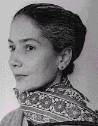
Here's what I've written and submitted to the Bali Adverstiser, in the regular column on the Ubud Writers Festival 2006:
Acclaimed author Anita Desai is guaranteed to add fuel to our theme Desa-Kala-Patra. Throughout her novels, short stories and children’s literature, Desai often focuses on the dilemma of identity and family relationships often in context with India’s recent social changes. Desai has received numerous literary awards and her work is touted by English professors from Princeton to the University of Hong Kong.
A sensitive heart and a bold hand synchronize in Desai’s work, giving the reader immensely rich reading experiences. Her created characters linger on in the mind, sculpted with substance, even in her shortest short stories. To read Desai is not to be overwhelmed in flowery descriptions, but to be allowed to observe salient moments of revelation and transformation. Preferring to reveal truth over sentimentality, Desai isolates the details that matter, with critics and admirers comparing her to some of the best modernist writers, including Virginia Woolf and T. S. Eliot.
Desai’s subjects are often seen captive in the walls of the home, or in a confining social convention, but she lets the reader see their hopes, pleasures, and compassions. Never claustrophobic, Desai’s characters’ domains and inner selves are given distinction and quiet dignity amidst an unyielding world. A tale about a going-away party, in her delightful Games at Twilight and Other Stories, to which many an expat can relate, is full of water metaphors to show a queasy sense of instability.
Having an affinity for both India and the west, Desai has a true familiarity with marginalization and dual ethnicity. Her mother was German, but adapted easily to life in India. The biggest difference between Desai’s parents and those in her neighborhood is that she and her sisters were encouraged to read the best English literature. Even as a 6 year old, she knew she would become a writer. Today, when she teaches creative writing, whether it be in New York or Cambridge, Desai emphasizes practice, in the same way that a musician must practice. But she also encourages reading itself.
Indian society is a popular subject matter today, and there are seemingly countless hot subcontinental writers. What really sets Desai apart is her deft use of language and ease with creating characters which ring true. Her writing is a popular scholarly subject, with just as many books about her work as books authored by her.
We’ll never see her work distinguished in the UK’s annual “bad sex in fiction” literary stakes (Salman Rushdie and Arundhati Roy have had that dubious honor). Desai has been shortlisted for the Booker Prize three times and can count Rushdie himself amongst her many fans.
Suggested pre-Festival reading from Desai: Games at Twilight and Other Stories, Clear Light of Day, Baumgartner’s Bombay, and Fasting, Feasting. Desai adapted her novel In Custody for the screen in the Merchant-Ivory production of Hifazaat; possibly can be found on DVD, but don’t bring a pirate copy to the book signing! A Festival lunch with Desai will be a sure sellout this October.
Sunday, July 02, 2006
What Joe Lavin Wrote, December 30, 2003
I just love to read bad sex scenes. The Brits have a great award for it, not that there's a prize or anything. Salman Rushdie and Arundhati Roy have been chosen in past years... what's the deal with Indian writers and bad love scenes???
I quote from Lavin's website:
At any rate, 'tis the season for wacky end-of-the-year awards. One of the most famous, the Bad Sex in Literature Award, was recently presented in London. Each year, Literary Review gives this award for the worst description of sex in a novel. Aniruddha Bahal won this year's prize for his novel "Bunker 13," which featured this stunning passage:
"Your RPM is hitting a new high. To wait any longer would be to lose prime time... She picks up a Bugatti's momentum. You want her more at a Volkswagen's steady trot. Squeeze the maximum mileage out of your gallon of gas. But she's eating up the road with all cylinders blazing. You lift her out. You want to try different kinds of fusion."
Interestingly enough, Bahal was also a finalist for the Bad Automotive Reviews in Literature Award, an equally prestigious though oft-ignored prize. Another passage contains this bewildering line: "Her breasts are placards for the endomorphically endowed." I don't even know what that means, but I bet it's got all those people over at yourdictionary.com really turned on.
http://joelavin.com/awards.html
Sunday, June 18, 2006
Don't Know Why... There's No Sun Up in the Sky...
Don't know why
There's no sun up in the sky
Stormy weather
Since my man and I ain't together
Keeps rainin' all of the time
Life is bare
Gloom and misery everywhere
Stormy weather
Just can't get my poor self together
I'm weary all the time
So weary all of the time
Since you went away
The blues stepped in and met me
If it's here to stay
Old rocking chair will get me
Every night I pray
That the Lord above will let me
Walk in the sun once more
by Ted Koehler and Harold Arlen
What the hell is going on with the weather here in Seraya!?
It is supposed to be the dry season, and instead we are getting rain, rain, rain.
It is great for my garden, but I suspect Al Gore is on to something in his global warming lecture series and popular flick.
Diana Darling: Bali's Jane Austen
Preview of upcoming Bali Advertiser article...
Is it possible that we have a Jane Austen in our midst? Believe it! Diana Darling’s The Painted Alphabet, based on a Balinese tale, reveals a similarly luscious talent and a sharp eye for human intrigue. Using graceful economy and incisive wit, Austen and Darling are master novelists, joyfully exploiting the vagaries of human relationships, in a format that ends with all loose ends ever so neatly tied up. Enak!
Ubud’s Darling was part of the influx of hippies and artists who sought in Bali not just an alternate lifestyle but an alternate universe. The mystical culture of Bali has great appeal, but to some seekers, like Diana, it held the promise of discovering the unseen.
“We were temple-mad… scouting the island for good temple festivals… [meaning] that it had dancing or trance; otherwise there was no point in going. …I longed to go into a trance,” Darling writes in Bali Kini, 1998.
Although she owns up to having once been “the most ridiculous, obnoxiously pedantic Baliphiliac on the island,” her explorations have rewarded her. Today she exudes an air of wisdom and good humor, in her writing and in life. She’s sensitive to village ways, more than happy to live in a Balinese household, and counts Balinese elders as some of her greatest teachers.
Her first novel, The Painted Alphabet, named a “treasure” by Periplus, and “dazzling” by The New Yorker, deserves top honors in the plethora of books penned by those smitten with the island of the gods. A thrilling story of love, loss, sorcery, and triumph, Darling gently binds the reader in a spell using precise pacing, humorous and evocative descriptions, and an assured knowledge of Balinese tradition.
A strong thread of Hindu dharma is laced through the novel, especially the formula for propriety which is this year’s festival theme: Desa, Kala, Patra, the belief that identity is informed by circumstance. Perhaps the book could be described succinctly as a lesson for accepting change.
She’s got a second novel in the works, which she calls “a fictional account dealing with the history of tourism in Bali,” and, perhaps most exciting of all, she’s writing the libretto for an opera based on The Painted Alphabet. Bali is eminently suited to multidisciplinary creations. Some of the most memorable moments of the past two Ubud Writers Festivals were performances of songs and theatre.
“I’ve always wanted to see The Painted Alphabet as an opera,” Darling wrote to this reporter. “A friend of mine recently suggested that we develop it as a theatrical piece. I saw a lot of music in it, and finally the penny dropped: make it all music. The dialogue is necessarily very concentrated. It’s reduced to its lyrical essentials, which is a way I like to work.
“I envision a musical style that is very much its own and that delivers the requirements of the story and the verse in which it’s composed. Because the setting is Bali, we want certain Balinese musical elements, but not straightforward gamelan either. It will be very eclectic.
“As for the writing process, the idea is to think in songs, not in narrative. You have to find the emotional pitch of the moment that requires that this particular dialogue MUST be sung. There is room to indicate stage directions as well, and I have quite specific ideas of things I’d like to see in the production. There will be some use of film in different styles. But all this is in a fantasy stage right now: that is, getting the fantasy down on paper.
‘My understanding is that the libretto is the architectural structure on which the composer builds the music. No, we haven’t begun looking for a composer. I want to finish the libretto first, or at least have a complete draft, before presenting it to a composer. That’s only fair. Then of course I would like us to collaborate closely.”
Not without a touch of irony, Darling says that “my only requirement of the music is that it be exactly right and very beautiful.” Her stunning prose deserves no less.
Diana Darling was born in the USA in 1947, studying acting in New York and performing Off-Off-Broadway from 1970 to 1974. She lived in Carrera, Italy, carving marble (1974-80), and studied drawing in Paris (76-78). Moving to Bali in 1980, she soon married Australian filmmaker John Darling (until 1987) and is now married to A. A. Alit Ardi of Ubud. She’s been editor-in-chief for the highly praised Latitudes magazine, and has contributed essays to many publications on Bali style and culture. Alongside her personal works in progress, Darling has a day job as a copywriter.
Friday, June 16, 2006
Back in Bali
Picked up The Man at Ngurah Rai Airport and went to ...you guessed it... Makro! The raja of grocery stores here in the isle of gods and rajas.
Just checking in. No news to report, except that I ran into friends Sue and Peta in the space of 2 minutes (outside of Dijon, how terminally EXPAT is that?). I don't see anyone outside of Amlapura postal delivery men and the boys at the pool hall across the street. So it's mind boggling to see these gals in so short a time span.
Feel pretty good about recent interview with Diana Darling. She's a wonderful writer. It could be that Bali is a damn good environment for honing one's writing skills.
Also feel pretty good about short story sent to Nury of the Asian Literary Review (née Dimsum).
Watch the Bali Advertiser for the DD interview.
Tuesday, June 06, 2006
666
666
I wish I had some checks to sign, or more letters to write. I am unwilling to waste this amazing date!
I am stuck at the internet cafe in Amlapura, sharing a dialup line with three other people, trying to get in this blog before it's time to go home to lunch.
Ariel and Kim and I arrived in Bali late last night. A successful operation all around, with no confiscated items by homeland security airport thugs.
Bali had the cutest black lab sniffer dog give all my bags a big wagging once-over, and it's a good thing they train those doggies to detect cocaine and marijuana, because if they ever get one of those guys to sniff out furniture polish, I'm dead.
Odd weather lately in East Bali, with rain clouds whirling overhead, patches of intense blue in between. I mean, is this June or January? Wet deck in the morning tells me our global weather is messed up this year.
Okay, eager to plan the next few days with the girls. I'll make the suggestions and they'll have to decide when to do what. On their list: rafting, surfing, and a visit to M Bar Go because Georgina Barnett is the PR girl there.
Spotted a very cool deal from the Hyatt here, where two nights cost only 988,000 Rupiah. Ariel and Kim are considering taking that on.
Horrid dialup situation keeps me disjointed and boring. Sorry. On 6/6/6, I am boring.
Sunday, June 04, 2006
Tienanmen Square 06
Without benefit of Cantonese ability, I can report only that the candlelight vigil was unreasonably short tonight. In previous years, I have left Victoria Park long before the commemoration was over.
Yet, it was still moving, with thousands of Hong Kong people, from all walks of life, humbly sitting on asphalt with their candles held high, singing songs of their passionate remembrance for the democracy demonstrators.
In the end, a Falun Dafa adherant spoke with me and my daughter and her friend, as hordes of people filed out of the park, telling us that HK people are under constant surveilance by the government in Beijing. Was this the reason the event broke up at 10 pm? I don't know.
More later. Must sleep.
Tien An Men Square Commemorative Guilt

Aiya!
Yesterday from 8 to 10 I was online doing a United Airlines survey while a number of artists were at ParaSite in an art performance in remembrance of the massacre at Tienanmen Square.
The extenuating circumstance was that I'd failed to read HK Magazine's calendar. Naturally, I read it this morning over a cup of Java.
Okay, today I vow to get to exit D of the Causeway Bay MTR station to see another perf on the streets. Will bring camera.
HK Live 2006
Got back just now from the Fringe... HK LIVE event, Channel V showcasing 3 local talents.
Fun pop band "Maladjusted" at first, 5 Chinese youngsters that sound like Oasis without attitude. Actually pretty enjoyable. Next band "Vibration" funkier and dancier and canto popier (rhymes with copier) with girl singer (singing spotty but stage presence cute & cheerful) and plenty of sampling & effects.
Final band "Robot," tonight encarnated as a quintet of cool nerds, mostly white, including two intense bald guy types, with a couple of tables of mixed electronics. Worth the price of admission was their 5 part film on evolution, filmed in HK and definitely inspired by bellbottom science (Open Learning, for readers who are not members of my family).
Robot would screen a part of the video and then pause it and play a tune (that electronic dance stuff for which boomers like me haven't quite developed a taste) and then go back to another section of the movie... hilarious sequence of cave men days filmed atop a typical hk rock outcropping, with massive HK urban highrise background.
Came home smelling like an ashtray (HK lags behind Oklahoma City and New Jersey, do you believe it?) and curious to know if I can fall asleep.
Saturday, June 03, 2006
The Forgotten Language
I emailed this to my son, who's fluent in Putonghua and can hold his own in hockey rink Cantonese:
Humbled in Honkers:
I flag a taxi, I jump in, expelling "Tai Hang Douh" as quickly as possible, for it's usually when ya go too slow that expat Cantonese doesn't cut it. I follow with "Wong Fung Toi", simply because Wong Fung Terrace is the little private road that I really mean, but I want him to get to Tai Hang Douh first.
"Wong Fung Toi?" driver intones back at me, genuinely puzzled, tapping the break in the middle of Lower Albert Road. He makes as if to go down Ice House Street, a true disaster.
"Wong Fung Toi, yes," I say. He's said it just like I did, and I am pretty darn sure I said it right.
Back and forth we verify and confirm and act like parrots, and I desperately add, So Kon Po, and he's all ahhhh! So Kon Po! and I think s**t, no, I don't want him to take me to So Kon Po... what the hell is Cantonese for "above?" And my mind spits out beautiful Indonesian sentences for perfectly explaining what he's gotta do.
"M'hai So Kon Po," I tsk, exasperatedly. I hope to God that I look like I am searching for a better way to explain myself, but how do you say in Cantonese, "I beg your pardon, but it seems to me that my Cantonese, formerly quite adequate for giving a taxi driver directions, is now virtually forgotten, replaced instead by halfway decent Indonesian?"
I sputter and pray he doesn't turn up towards Midlevels, as we are now racing along the underside of Government House towards Cotton Tree Drive.
He goes to his cell phone and speaks to dispatcher/wife/gambling buddy/random number: "gonggingjungmanggongwongdong Wong Fung Toi, ah?"
pause.
"Aaaaaaahhhhhh! WONG FUNG TOI !!!!" What's Eureka! in Chinese?
He hangs up with a smile and says to me, and I swear to God there is no difference between the two pronounciations, "M'hai Wong Fung Toi. WONG FUNG TOI ahhh" in a helpful, not at all insulting voice. Although I proffer a sincere, "duih m'jih", I'm thinking what the Sam Hill am I going to do next time I'm in a taxi and I want to get to Quentin's house? Taxi driver is chuckling to himself in that head shaking manner of "now I've heard everything! Wait'll the wife/drinking buddy/guys at the shop/ kids/dog hears THIS one!"
Readers, please do NOT tell me that wong fung toi, if intoned in a certain way, means "s**t my pants" or "swim with donkey" or worse. Then again, tell me how that would be pronounced so that I will never make that mistake again!
Friday, June 02, 2006
Hong Kong: a stranger again
Well, it had to happen. I have been out of Honkers so long that I perceive all the things a stranger notices:
the dense crowds (and is EVERYONE 19 years old?)
the air conditioned interiors
the air
the gaga, overwhelmed faces of backpackers
the lack of good street signage
the relatively dressed-up appearance of young expats
the wrought iron bars on everyone's windows
concrete retaining walls with mortar blackened by mold and humidity
I checked into Susan and Q's nice trad HK flat (you know, one apartment per floor, no amenities, tiny kitchen, large lounge-dining area, surprisingly sizeable balcony). Hacked into the network (I think I'm not the only person on Q's line, it's a bit slow), and planned my stay. Had a couple hours in Causeway Bay, in search of a good adaptor (forgetting to pack one is another sign of a clueless stranger). Of course, along the way I bought eye makeup and yogurt. Tried to figure out the green minibus number that runs up along Tai Hang Road.
Got in, my calves aching from the walk! What walking I did, when I lived here.
Friday, May 26, 2006
Ashes and Snow

Man, could some clever individual ever make a great parody of Gregory Colbert's Ashes and Snow.
Saw it on its last day at the Santa Monica Pier, as part of mega festivities for Grinch Girlfriend's Graduation.
I will suffer the slings and arrows of having an unpopular opinion, but I didn't really like the famous exhibition of beautiful native gals and kids cavorting with animals (most of them tamed).
Short critique: gorgeous cinematography elevates genre of pinup art.
Politically chic critique: 19th century glorification of the exotic "other" is alive and well in elephant-dung filled ponds where cafe-au-lait-skinned females cavort in exquisite slo-mo alongside gentle beasts.
Sorry... it was like visiting clown paintings on velvet, painted by David, where I would surely opine, "I bow to the grandmaster of schlock!"
Sunday, May 14, 2006
Saturday, May 06, 2006
Changi Airport: The Swimmer's Home Office
Hell, I post more stuff at this airport than any other place in the world. They have faster internet than what my cellphone - and - bamboo - pole - antenna setup gives me in Bali. They have utterly FREE connections, unlike casa verde in California. And I find myself standing in these air conditioned halls more often than any healthy person should.
So: the blog.
The news:
Successfully edited together Galapagos and Machu Picchu DVDs, so look out, all of you who requested same. Jay kept the time down to feature length movie... not baad, if you like Directors' Cuts!!
Won the first of this year's Ubud poetry slams. Too cool!
Note to self, and to Seminyak Business Dewas and Dewis Association: Jalan Dhyana Pura is looking like hell these days! The abandoned buildings which formerly housed small night clubs and boutiques are covered with trash. It brings down the atmosphere of the whole street. Please form a beautification committee or no one is going to want to stay at the Sofitel or eat at Gado Gado.
Thursday, March 23, 2006
I Ain't Talkin' 'Bout Bolivia
You have to visit http://www.kissthisguy.com/ to understand the title to this post.
When a person such as myself is light-headed, strolling around at 8,000 feet, the mind does funny things. "I ain't talkin' bout Bolivia" runs through my head like a munching earwig out of a sci fi horror story.
How many times do we get the words wrong in a rock n roll song? The website above is devoted to this universal problem. You can look up the lyrics to a song and record your own mis-readings (or just read others' and have a good laugh).
Go to the website above and search "I'd Really Love to See you Tonight", where the lyrics can be found. I mistook the line, "I'm not talking about movin' in.." for "I'm not talkin bout Bolivia," but of course, that's just too preposterous for a love song, so I guessed (for years and years) that the right words were "I'm not talkin' bout believing ya". Then I went to this amusing website and realized that I had a double "mondegreen."
Anyway, someone named Betsy Gordon had the same misreading of the line.
bolivia... I'm not even THERE.
* * *
Which brings me to South America.
I just arrived in Quito, Ecuador, which looks modern and clean and green from the sky (in a landing reminiscent of Hong Kong's old Kai Tak Airport). But it is actually a little grotty around the edges, yet a chipper town with a fair mix of ethnic groups. The mountains are within view of my little desk at The Magic Bean, which is a kind of backpacker nexus in the Mariscal Sucre.
Jay and I got a little room here with private bath, and we look out over the lavanderia which is hopefully not destroying my 3 kilos of expensive North Face FIT wear.
Big welcome from the harried but capable Miguel Garcia, who got us booked on the Angelique sailing boat around the Galapagos next week. I have been inside only three buildings here, and I am already seeing a type of beautiful plank with large gaps between... definitely some sort of exotic hardwood.It seems that the traveler is drawn to these backpacker magnets like this 'hood, or the old town of Cuzco, Peru. I guess it takes some effort to get away from these places, because it is mighty convenient to stay there.
With Cuzco as our base, we trekked the Inca trail and soaked in Machu Picchu; then we trudged through mosquito-infested rain forest to see toucans and caymans in their natural habitat. In true backpacker fashion, we met up with Lai Chee and her traveling companion Bret. We looked like a thousand other moneyed gringo travelers who are playing explorer.
Winawayna is a not-to-be-missed Incan town on the outskirts of Machu Picchu. I can see why the prince made his holiday home at Machu Picchu, but if you want mystical magic, check out Winawayna. It is an agricultural settlement with tons of terraces stretching downwards in a funnel fashion on a mountainside. A couple of modest temple buildings are there, as is a priest's house. Homes for support folk are there, too, and it must not have been a huge town. But what a setting. Jagged mountains with permafrost are directly across from the settlement, giving the feeling that you are embraced by the security of the terraces and the mountain spurs but held aloft in the top of the world. It is impossible to sit there and not feel as if you are in the presence of majesty. And yet you are held warmly, like riding on the shoulders of an adult when you are a child.
Tuesday, February 28, 2006
Giordano RULES!
Got to Macau to visit my hubby while he's here consulting to some big ol' slot machine company.
Macau weather still cold, and I knew I'd be back in northern California for a short time, so I thought I'd hit the clothing shops. First off, before I even get so far as the post office, I see one of those white-on-white clothing outlets that are so typical of Hong Kong and now, apparently, Macau. I go in and buy two bursting bags of ski jackets and fashion jackets and shirts and pants, some with the labels intact enough to know that I'm paying pennies on dollars. The whole haul is less than one hundred US dollars. All wonderful.
Probably the coolest thing, now that I've lived in Bali for 4 or 5 years, was that the prices were fair and marked indelibly on the tags. I mean, I haggled a little at the total, and I think the cashier knocked off MOP5 (I was paying in HKD, anyway, a nicer currency), but the main thing is, the haggling didn't DECIDE the sale.
Ladies of Bali Expatria, you tell me: ain't it a bitch to go into some cute little clothing shop, and there are no prices? It's the most popular Balinese dance: Shopping Joged. The steps are familiar to us all. You have to ask the nearest shopgirl for the price of every single item. You raise your eyebrows at the crappy first price. She counters by saying, but you can have a discount. You put one thing back, you pick up another. You repeat earlier steps. You hold the big pile of clothing and approach the cashier, asking for 50% of what you think you should be paying. She counters with a price that does not take into consideration the proffered discount by the first shop girl. You laugh gaily and point out the delightful mistake, being careful to say that 75% of what you want to pay is really more reasonable. They say no. Expert dancers at this point take out a calculator, and key in a slightly lower price for you to see. You say no, look to the door, offer 90% as a last price. They say no (boy, isn't this exciting?) and so you walk to the door, casually offering 100% of your own best price. They will either say yes or no, and if they say no, you better not go walking back in there unless you enjoy losing face. The end is the loss of your hard work choosing, calculating, and negotiating.
In Hong Kong and Macau, by contrast, each clothing shopper is on equal terms with the next. Maybe the shopkeeper's friends get a good deal every once in a while, but really there is a general equality amongst all punters. You go in, you see how much you gotta pay, you pay it, you leave. Surgical shopping.
Now, as I rounded into the beautiful plaza in the heart of downtown Macau, I spotted a Giordano shop. Giordano is a total Hong Kong phenom, beating American GAP to smithereens on several levels. Sometime back in the 60's, a delegation of Italian manufacturers came to Wanchai to show real style to Hong Kong people. Well, it convinced the Hong Kongers that Italian stuff is synonymous with style, but it also gave HK manufacturers a lot of great ideas. Giordano, Balino, and myriad other Italian-sounding style houses sprang up.
Giordano survived, with a difference. In about 1993, they decided that they would buck the trend of HK service and offer friendly salespeople, unlimited use of the dressing room, and dozens of available colors to choose from. No more "sorry out of stock", no more frowning girls ignoring your questions, no more exasperated sighs when you decide to not purchase an item, no more "you can't try on. Stretch fabric." Giordano suddenly became a frightening place for the jaded Hong Konger, for the barrage of smiles and hellos upon entry to the store. Tons of dressing rooms, girls searching earnestly through back rooms looking for extra stock... it was nothing we'd seen before. West of Hawaii, anyway.
But it stuck. To this day, Giordano is as ubiquitous in Hong Kong as Starbucks in urban America. And, true to form, as I entered the Macau Giordano, I was greeted by half a dozen young clerks, all smiling like Taiwanese or Samoans or Balinese or... anything but south Chinese!
I tried on twelve outfits, the girls helped me arrange shawls, they looked in the back for other sizes... it was quite a morning. Their help and suggestions and patience with me paid off for them. I laid down another hundred greenbacks. This time for several of their fabulous designs... the knit torquoise shrugs, the stretchy smooth long sleeve t shirts, a belt, shirts for my man, and probably would have bought more if I didn't already have a tonnage problem. Such great designs, such great fabrics, such unbeatable prices!
It dawned on me later that I had asked one of the salesgirls for something in pidgin Indonesian. She didn't even pout. She probably just figured I was German, struggling with the English language. Not that there isn't a German out there whose English is far superior to most American's.
Anyway, next stop for me was the luggage store. Had to buy a suitcase for all the loot.
But Giordano
Macau

Macau is a boom town.
It has everything a boom town has: too many cars, too many people, a thousand construction projects, and electricity in the air.
I first saw Macau in May of 1990. It was humid, still, and sleepy. We rented a "moke", which looks like a stripped-down VW Thing, and I drove it over the Macau-Taipa bridge. I think I saw a taxi driving the other way on that bridge. Macau was THAT sleepy.
In those days, the Praia was shaded with trees, and, despite the heat, it was actually a pleasant place to stroll. Start from the frightening statue of Ferreira do Amaral on horseback, near the Lisboa, towards the Pousada Sao Tiago, fortress-turned-hotel. In pockets of shade, grungy old cycle rickshaw drivers would be napping or reading the paper or just waiting for riders. It was a quiet place.
Nowadays, the Praia is still mostly a deafening construction site, crammed with ugly apartment buildings. The part of the Praia Grande without construction is a little nicer, but now the sea has been shut out and the water is a kind of lake or estuary, with a massive fountain. At least now many of those old buildings like the Clube Tenis Sivile is
Prambanan
It seems that sometimes I look at some ancient wonder or breathtaking landscape and think, "I've got to bring ------ (a loved one) here!" I flash on the logistics of such a visit, and it will seem totally do-able. Within even just a year or two.
Or I'll be at one of these places and think, I really need more time to fully appreciate this. I'll bet I can come back next year, but then I'll spend a week here. It seems to be logical at the time.
It took me 26 1/2 years to get back to Prambanan, a Javanese Hindu temple complex left over from the 12th century. Just an hour outside Jogjakarta, Prambanan was a ruined mess. It was roped off from anyone who was hoping for a close look at the friezes, but served as a backdrop for Ramayana dance performances at night.
Jay and I went to one of those dances in the first week of our honeymoon. The Javanese dancing was bold and theatric, the acrobatic men's dance contrasting beautifully with the graceful women's. There was fire onstage, too, pyrotechnics being something you don't see too much of in the US. I recall that several hundred European tourists were there to see the performance with us. Enormous, gleaming white buses took them out to the site. And many of them were staying out at the nearby Sheraton.
Of course, Jay and I were either at what's now the Natour, or else we'd moved down Jalan Malioboro to stay in actual air conditioning at the Mutiara. But the Sheraton seemed to me like plush pampering, perhaps too removed from the hustle and bustle of the city.
But in the company of my dad and the tour guide Popo (seems to be a common Javanese man's name, like Bambang), I revisited a revamped and clean Prambanan, one I could walk all around and upstairs and view closely all the reliefs. Being Hindu, it was a little more exuberant than Borobudur's meditative format. And the Ramayana comic book panels all around the walkways served as more entertainment than religious lesson. But there were stupa shapes all about, something I did not remember from 1979.
Clearly, my dad loved Prambanan and was glad we didn't spend another minute in Jogja looking for silver or batik.
We left before sundown, had an airport meal, and caught our plane back to Bali. Cakra picked us up and we were back at home by midnight.
Monday, February 20, 2006
The Frozen One
If you google "frozen Marcos", you'll happen on a lot of texts about his swindles against the Philippine people. And you may even find a Latina's porn stories site. But if you find anything about Ferdinand Marcos lying in state, add the site address to my comments area.
Thing is, I was not allowed to bring in a camera when I visited the body the other day in Ilocos Norte.
More later.
Thing is, I was not allowed to bring in a camera when I visited the body the other day in Ilocos Norte.
More later.
Thursday, February 16, 2006
Abdul Aziz: the painter, sculptor, violin maker
Dateline 11 February 2006
Abdul Aziz: The painter, the sculptor, the violin maker
Denpasar, --- Artist Abdul Aziz created the painting known as the “Mona Lisa of Bali”. Yet few people outside the circle of art-collectors have ever heard of him. A highly talented artist and musician since childhood, a member of the Student Army during the struggle for Indonesian Independence, for which he later was decorated with the “Tanda Jasa Pahlawan” and other awards, Abdul Aziz was a recipient of an Italian Government scholarship which enabled him to spend five years in Italy, during which time he received two Diplomas from the Accademia di Belle Arti in Rome, for Painting and for Decoration.
On his return to Indonesia in 1965, Abdul Aziz settled in Bali, lecturing at Udayana University, and making his home in Ubud in 1970. Here he painted some very famous works, ‘coming out of the frame’, which are held permanently in the Abdul Aziz room at the Neka Art Museum. In 1983 a British tourist, Mary Northmore, saw his work and expressed an interest in meeting the artist. They were married in 1988 and set up home together just outside Ubud. Shortly after this Mary founded the Seniwati Gallery of Art by Women, to this day the only gallery of its kind in Asia, based in Aziz’ old studio in central Ubud.
Abdul Aziz not only painted and sculpted but he was also a serious musician and, towards the end of his life, dedicated his energies to making violins, as he said:
“To prove an Indonesian could be as good as Stradivarius” .
Many collectors complained to him and to Mary, that they weren’t able to get paintings by Aziz, but he was not interested in fame and fortune, preferring to stay home and play music rather than assume the role of ‘publicly famous artist’. This is why so few people know of his amazing life and work. One year after Abdul Aziz passed away, on January 1st, 2003, Mary decided that she wanted to create a book about her husband, to show the world what an extraordinary artist he was. She tracked down his paintings and sculptures, interviewed friends from his childhood and youth, his Italian years and later, and has combined them all into a book “Abdul Aziz: The Artist and His Art”, published in November 2005.
The National launch of the book on February 11th at Gedung Arsip Nasional, Jl Gajah Mada 111 included addresses by HE Charles Humfrey, CMG, British Ambassador, Suteja Neka, and Mary Northmore, with a Violin tribute to Abdul Aziz by I Gusti Bagus Wiswakarma, together with an exhibition of Abdul Aziz memorabilia and violins.
That's the extent of the official press release, but let me add that this extraordinary man has been given the extraordinary honor that every hardworking artist would want for him or herself. It's a remarkable book, a beautiful tribute, a meticulous history.
Tuesday, February 07, 2006
Boston Globe Editorial
Thank you, Boston Globe, for this opinion. This nails it.
Forms of intolerance
February 4, 2006
FREEDOM OF expression is not the only value at issue in the conflict provoked by a Danish newspaper's publication of cartoons satirizing Islam's founding prophet, Mohammed. The billowing controversy is being swept along by intolerance, ignorance, and parochialism. The refusal of each camp to recognize and respect the otherness of the other brings closer a calamitous clash of cultures pitting Islam against the West.
No devotee of democratic pluralism should accept any infringement on freedom of the press. But the original decision of the Danish paper, Jyllands-Posten, to solicit and publish a dozen cartoons of the Muslim prophet was less a blow against censorship than what The Economist called a schoolboy prank.
A Danish publisher of children's books had complained of trouble finding an illustrator to draw a likeness of Mohammed. Acting on an assumption that there should be no reason to refrain from publishing anything in Denmark that was not racist or an incitement to violence, the Danish paper then printed the 12 cartoons in September.
This was a case of seeking a reason to exercise a freedom that had not been challenged. No government, political party, or corporate interest was trying to deny the paper its right to publish whatever it wanted. The original purpose of printing the cartoons -- some of which maliciously and stupidly identified Mohammed with terrorists, who could want nothing better than to be associated with the prophet -- was plainly to be provocative. Islam prohibits the depiction of Mohammed in any way, whether the image is benign or not.
Other European papers reprinted the cartoons in a reflex of solidarity. Journalists in free societies have a healthy impulse to assert their hard-won right to insult powerful forces in society. Freedom of the press need not be weakened, however, when it is infused with restraint. This should not be restraint rooted in fear of angering a government, a political movement, or an advertiser. As with the current consensus against publishing racist or violence-inciting material, newspapers ought to refrain from publishing offensive caricatures of Mohammed in the name of the ultimate Enlightenment value: tolerance.
Just as the demand from Muslim countries for European governments to punish papers that printed the cartoons shows a misunderstanding of free societies, publishing the cartoons reflects an obtuse refusal to accept the profound meaning for a billion Muslims of Islam's prohibition against any pictorial representation of the prophet. Depicting Mohammed wearing a turban in the form of a bomb with a sputtering fuse is no less hurtful to most Muslims than Nazi caricatures of Jews or Ku Klux Klan caricatures of blacks are to those victims of intolerance. That is why the Danish cartoons will not be reproduced on these pages.
© Copyright 2006 Globe Newspaper Company.
Shame on you, Denmark! Cheers to James Zogby
Okay, I'm really angry about the European press jumping on Denmark's bandwagon to print those obviously inflammatory caricatures of Mohammed... all under the guise of making a statement for Freedom of the Press.
Yes, the press has the freedom to publish garbage, to start arguments, and to offend. But don't we as writers feel any sort of responsibility to be human? To have a soul? To relate to our fellow humans in a helpful manner?
Yes, Denmark had a right to publish those pictures and they could publish a picture of turds on a toilet seat, too. But what purpose do these things serve? The same: baseless offense.
I heard James Zogby speaking on the BBC the other day. He's the head of a prominent Muslim organization in America, and you can click on his name in the title to get to his bio. He really pointed out the main thing about this whole Denmark debacle... how silly it is (and ultimately how destructive) to knowingly publish things that will only offend.
I felt very sorry for the Danish table tennis players who will not compete in their tournament in the Emirates. This is exactly the sort of thing that happens when the press thinks only of its great rights and freedoms, and forgets that it is meant to be a vehicle for news and useful information.
Angle, angle, side
Remember trying to get the Geography teacher to write angle side side on the chalkboard? I don't think anyone's ever succeeded in getting more than a wry laugh out of the teacher. I do remember Mr. Wright at Berkeley High, who was young and funny and touted the pool table as a good learning tool for the course. He never fell for that one.
Why do I entitle this entry with AAS? Because that's the name of a village where there's some pretty nice snorkeling!
I'm pressed for time, and I can't enter anything else right now, but keep watching this space for news about Aas Beach and the Pondok Belgia.
Why do I entitle this entry with AAS? Because that's the name of a village where there's some pretty nice snorkeling!
I'm pressed for time, and I can't enter anything else right now, but keep watching this space for news about Aas Beach and the Pondok Belgia.
Friday, January 27, 2006
What Enlivened the 2005 Ubud Writers Fest
The Second Great Annual Ubud Writers Festival was just as great as number one, if not better.
If All Things Childlike was an unofficial, underlying theme to the 2004 fest, All Things Sexy was 2005’s. Attendees were treated to an epic love poem set to avant garde music, a raucous evening debate on whether men or women write the best sex scenes, and the President and First Lady of East Timor read selected texts from their courtship in an intimate Cliffside hideaway.
One of the last decade’s hottest love stories, The English Patient, was perhaps the fastest mover in the festival book bazaar. This makeshift bookshop had the atmosphere of a cleaner, neater Ubud marketplace… boxes of great stuff to buy, colorful displays, a tempting gauntlet for attendees to pass through, to get to all events held at the Indus. English Patient author, Michael Ondaatje, signed copies and was a genial guest. At times thronged by fans, lit star Ondaatje was friendly and a good listener to boot. I don’t know if there’s another festival out there which offers such an atmosphere of intimacy and leisure.
This festival is part intellectual salon, part master class, and part dinner party. The fact that founder deNeefe is a restaurateur deeply informs the tone of the week. There is always food, drink, a comfortable place to sit, and someone wonderful to sit next to. Seemingly all of Ubud, from the grounds of the royal palace to the charming restaurants that serve as venues, constitutes the setting. Wine (courtesy Australian consulate and any number of wineries) flows gently, menus abound with the best international flavors, and the whole town smiles warmly. This is entertaining on a very grand scale indeed.
The high-ticket literary lunches were in fabulous settings like the Maya Ubud (one of 04’s hot spots, too), luxurious Begawan Giri and the almost overwhelmingly grand Chedi Club. Unfortunately, the food at the lunches which I attended were not up to the level of the meals in the preceding year. Chicken breast and overcooked veggies followed by gelatin dessert is Hotel Banquet Cuisine 101. Bali is supposed to have great chefs, people. What happened? I suspect a profit motive, inappropriate on the hotel’s part, in what is essentially a PR opportunity.
A successful literary festival is not just about glitter, glam, and gladhanding. Some panels of writers had excellent, challenging moderators. Ubud novelist Jamie James, art dealer Mary Northmore, and renaissance woman Janet de Neefe were possibly the best, displaying fresh insights, and diligent research, with an attitude of humility and respect.
I felt several profound connections during this festival. Playwright and raconteur Putu Wijaya, speaking of his inability to be Balinese now that he is a citizen of the world, revealed some of the freedoms and bindings that accompany the third culture. I could also relate to Kirsty Sword Gusmao’s motherly ties conflicting with her other duties. She was as genuine and frank as my own mother, a great role model for me. An unexpectedly strong voice of female solidarity came from Ayu Utami, whose Saman was newly launched in English at the festival. Everyman’s eye candy in tight jeans and gorgeous face, Utami was nobody’s fool. During a progesterone-filled afternoon panel on underground Jakarta, the diminutive writer cried foul from the front row of the audience, when writers in the panel (all male) tossed off a general declaration that Jakarta sex workers love what they do. Perhaps I, too, had dismissed Utami as a sex kitten, for I looked at her in that heroic moment and thought, “yes, yes, you speak for me when I am intimidated.” And isn’t that the stock in trade of our best authors ? Truth and beauty wrapped in words.
Yes, time to wrap it all up. October 2006 is coming again and we’ll have another glorious smorgasbord of writers. Book your tickets to come to Bali and keep watching the Casa Luna website for details.
Wet, Wet, Wet
Wettest rainy season in my 5 years in Bali...
How to clean jamur (algae) off your palimanan stone steps, walls, statues, etc.:
1. Don't delay... the minute you buy your statue or build your temple or clad your balé in this lovely milky white sandstone, brush on silicone. You can get this at Cintra Warna on Jalan Imam Bonjol in Denpasar.
2. Okay, so you delayed and it rained. Your block of palimanan is now an ecosystem exploding like the Genisys Project in Star Trek. Don't even THINK of searching for Spock in all that green... just get it scraped off. If it's really bad, brush with dry kitchen/bathroom scrubber. Old toothbrush works great for those carved eyeballs and curley cues.
3. Resist the urge to hose it off. You will merely be feeding the algae. If you must use the water method, blast away with plenty of pressure and immediately follow up with step 4.
4. Mix 5 parts water with 1 part bleach and scrub, scrub, scrub. Don't let one drop of green remain. Leaving stains of black is not necessarily bad as this can add character to the stone, and you won't be able to get rid of those anyway, without actually scraping away parts of the stone itself.
5. Do rain stoppage dance until sun shines and dries palimanan.
6. Immediately coat with silicone and allow to dry.
7. Maintain stone steps by screaming at anyone who treads on them.
8. Maintain statuary by making daily offerings.
9. Move back to Australia or the States or wherever it is you came from, so that you'll never have to go through this nightmare again.
Monday, January 23, 2006
Buying Koi
There's a tale to tell, here, about buying koi fish in Denpasar. I will get to it later because if I sit here in this Sanur internet station and compose it, I will miss dinner at home. More later.
I am sick of being sold sterilized fish in Bali. I always seem to end up with ones that can't fertilize the eggs. So I vowed to go to Bali Koi, the shop near the central market, and ask the Chinese gal there if she can sell me breeders.
I am sick of being sold sterilized fish in Bali. I always seem to end up with ones that can't fertilize the eggs. So I vowed to go to Bali Koi, the shop near the central market, and ask the Chinese gal there if she can sell me breeders.
Saturday, January 14, 2006
Saab Story
Can a car actually be posessed?
I don't know about that, but I have an odd little tale to tell. It will be all over on Tuesday.
It started in the summer of 2004, when I became fed up with using so much money on rental cars. I was going in and out of America, always pouring money into the coffers of Dollar, Alamo, and Enterprise. I figured, I can just buy a car for the price of renting one for a few weeks.
I started searching Craig's List and found a pretty nice deal: A 1989 Saab. Asking price was more than $3,000, and it had nearly 100,000 miles on it, but it was in good shape, had a new top and a spiffy paint job. What was odd was that the woman who was selling it had a very unpleasant personality. She didn't seem to want to really get rid of the car. She only begrudgingly let me test drive it and overreacted if I made comments about the mechanical condition. I had to ask for a lower price (it had some flaws which put it into a lower blue book price range), she reacted as if I'd asked to buy her soul for five bucks, and time and again she was just very unpleasant to deal with. Worst of all, the car failed the smog test so badly that it was in the range of "gross polluter" and needed nearly one grand worth of repairs to get it DMV s*** list. I know why I didn't just walk away... because it is very difficult to make appointments, go see these used cars, make "carfax" searches, and so forth. And really it was a nice car. There's something very nice about the solid slam of a Swedish car door... the top down experience is second to none... it was a nice car.
Well, once the car was mine, I got my husband to fix the loose front seat. For you see the seller was a portly gal and had squashed that seat into a kind of loose position... I was weighing in at 120 lbs and would rock back and forth in the seat. I got the front shoulder joint fixed (sorry about the lay terms), got a new seat belt where her dog had chewed the thing to mere threads, and put on gorgeous new Japanese tyres. I sunk more into it than I'd paid for in the first place.
I did joke that this was my "Schick Disposable Car", rejoicing in the price of a used car, patting myself on the back for buying a used car rather than renting some Detroit detritus. Was I degrading the car? Was I hurting its feelings?
My friend Karen saw me in the car and said "it suits her", with an appreciative laugh, to her husband. But the car just never felt mine. I would continually find the seller's old objects inside the car... a bar of factory-wrapped glycerine soap, an old sock, a pair of scratched sunglasses. It was odd. I babied the car, wouldn't drive it long distances, wouldn't work it, wouldn't 'possess' it. I kept on thinking of that awful, snide woman who sold it to me. You know, I'd asked her if she had a name for it, as some people do. I mean, I used to have "Blue Car" and my brother owns "Zippity Doo-Dah" and Ann owned "Greenie." The woman said, with a kind of whiny voice, "just... 'MY SAAB'" Nuff said.
It didn't take me long to start calling it "the Turbo Tomato", but it just didn't sit well with me. I don't know why. I'd sit there in the driver's seat and realize that I was holding the wheel at arm's length.
I ordered a cool vanity plate from the state... the one with the palm tree and setting sun, with a bold "California" scripted across the top, my text reading, OR BALI. Get it? I had those plates on the car for one week, and then Jay drove me and my dad to a recital in one of Berkeley's nicest neighborhoods. It was September. It was a lovely crisp night. The music was wonderful, the people a delight. We walked back to the car. It was not there. It had been stolen.
Police told me that it was almost certainly a professional job, that even the turbocharger in one of those old Saabs is worth more than the price I paid for the car. It would already be at a chop shop, he told me. I was crushed. I had not insured it for theft.
In the trunk was my notebook of every craftsman who built my house in San Mateo County, the name & price of every fixture, appliance, flooring, and material. I had no other collection of those facts. I also lost a favorite balinese scarf (for when I ride with the top down) and a baseball cap from the diRosa Preserve. I mourned the loss of that notebook most of all.
It took a huge chunk out of the next two months to buy a replacement car. We went for a 1997 Chrysler Sebring convertible. We test drove eight of the things, maybe three mustangs, too, before we found the right one at the right price. It was a good car. We both love the better insulation (the Saab was noisy, even with the top up) and the better position for the driver (just look at how the guy drives his Saab in the film Sideways... the driver's arms fully extended to reach the wheel) and the firmer instruments. Instead of sporty red, our Chrysler is badass black. It is such a baaaaad looking car. Mean. But it's a workhorse. Hardly needed anything. In a few miles it was time for the spark plugs to be replaced, the usual 100K maintenence. But nothing bad after that. We love the car and it's done well.
Then I was in France this last month and my brother shot me an email: the cops called. They found your Saab in San Francisco.
I got back to the States and called the cops. The car was taken in a drug case. The woman driving it claimed that she bought it at a police auction. The cops examining the car found that although most of the VIN numbers had been scraped off, the thieves neglected to erase the easiest placement: on the inside of the door. My old VIN was there. Needless to say, there is possibly a crooked cop in on the case, and the detective who dealt with me was not saying much more. I went to the impound lot to get what was left of the car. 30,000 miles racked up on the odometer and everything inside trashed. The instruments were all loose and abused, the speakers shot, the seats torn. I mean, the car still looked cherry on the outside, but it was as if it were a rape victim... all the damage inside. Maybe worst of all, the nice factory-installed toolbox was gone, the trunk lock broken, and any vestige of my history with it obliterated. Naturally, both plates were gone. The Turbo Tomato had a tattoo, too: one of those incredibly ghastly truck driver "sexy girl" stickers on the rear passenger window. I couldn't peel it off at the lot. I had to drive home with it.
The instruments were so damaged that if I drove over a bump, the left blinker would go on. It stunk. The woman's ice cream wrappers and garbage were all over the place. The EQ was gone. The roof hydraulics shot. A mechanic told me it would be 5 grand to fix everything MECHANICAL that was wrong with it. "Do you love this car?" I could not say that I did. He recommended that I just ditch it. A wrecking yard might pay as much as a few hundred for it. Or give it to charity.
Well, after contemplating giving the thing to my daughter in LA (it's a safer car than the one she drives now, a Dodge that is the Corvair of the new millenium), I realized that I just want this sorry piece of metal OUT of my driveway, out of my life, out of its misery.
I called a world famous charity and they are coming to take it away on Tuesday. It felt very, very right to make that call.
Tuesday, January 10, 2006
On my mind
The ground has opened up now that it has finally turned warm. And all the trees are budding. The night air makes one pleased with being alive. The body is the package the spirit comes in. Evolpost. At death the body goes down and the spirit, the best, goes up into the sky of our hearts.
- Al Hansen
- Al Hansen
Saturday, January 07, 2006
Back in the 'Zone
Just got back a couple of days ago from the 48th state. Just business roundup and a chance to visit Barbara Rogers and Buddy and Sue.
It was a great visit to the Sonora Desert; I really love those cacti and sunsets. Fortunately, Buddy and Sue like to walk, and we took a morning stroll on the fab Sabino Canyon trail, although this time we were on asphalt almost the whole time... Jay and I are fans of the dirt trail itself, mountain lions be damned.
Did tons of driving and tried a few new roads, too. After Tucson, we made it up to Lone Pine very late one night, hoping to have 2 1/2 days of skiing at Mammoth. Wouldn't you know the whole town was blizzarded-in, and we just turned around, took off the chains, and high-tailed it to Shaver Lake. This is the amazing thing about the Sierras. Half the roads close in winter, first of all, but to get from Bishop-Mammoth Lakes to Sierra Summit in the lakes behind Fresno, it is best to be some kind of hawk. It's thirty miles or so by feathered wings, a whole day's drive by high-combustion Detroit engine.
Shaver Lake Hotel was cute & historic, but the walls are as thin as a Seabright beach cabana! The carousing, drunk guy who came into the lodge at 1:44 am our first night ruined my sleep. Ah, well, the slopes for the next two days were piled with powder (not all of it groomed) and we were in heaven.
Roared into Fresno just in time to have dinner with my dad and the head Curator at the Fresno Art Museum. My dad gave a nice talk, with about 24 slides, about his show there. It was a lovely evening and the show looks wonderful in the gallery they chose.
Sunday, December 25, 2005
Merry Christmas
Thorpes together again, at last.
Actually, yesterday we had the big Melcherts Christmas dinner at our place. What weather, for a Christmas Eve! We not only offered sparkling Burgundy (bought in a Shell station in Bourgogne) on the deck, but we had to put up our big Italian umbrella to keep at bay the hot sun!
Trad dinner of turkey with all trimmings, plenty of Pinot Noir, and lots of conversation. A few songs by the whole gang (Veni, Veni, Emmanuelle) and nephew Galen joined up with my brothers for Bach piece in Jay's office.
God, I'm exhaustipated! Great to have Evan and Ariel around us, again. Much laughter and crazy gossip, all that youthful energy. Today, Christmas, it rained. Just to remind us all that this is not Bali.
Monday, December 12, 2005
What I Read at my Mother's Memorial Gathering
Mary Ann Melchert was a great explorer. As most of us know, she was born into travel and rarely passed up a chance to go somewhere new. Like any seasoned traveler, she exuded confidence, spirit of adventure, flexibility and organizational skills. She could pick up and go anywhere at the drop of a hat.
She started her travels in a time and place that don’t exist anymore. There is no going back to the world of the British Raj, nor to a third world Japan newly released from occupation. I did not know the significance of my mother’s rootlessness until she gave me a copy of a novelist’s memoirs, Penelope Lively’s Oleander, Jacaranda, about the writer’s own attempt to revisit a childhood home in Egypt. Reading this book, I understood immediately my mom’s lack of a homeland, and that she was always more or less on the road. The book was her way of telling me who she was, where she was from, and what my own children were faced with, growing up in British Hong Kong. After I read the book, my mom told me that when she meets someone who is similarly displaced from their ethnic motherland, she feels instant kinship, in her own words, “It doesn’t matter where they are from, where they were raised, but every time, it’s as if I’ve found my long lost best friend.” This may answer why my mom was so close to the Salvadoran lady who manned the phone at the Honda repair shop, or with birds fallen from their nests, and with any number of displaced people.
Her language abilities were amazing. I saw her winning a heated, rapid-fire argument, in French, with a Geneva hotelier; singing about rice paddies in Tagalog, and charming a Carabiniero directing traffic in Rome.
Travel literature, including maps, was of particular interest to my mother. She had every AAA map to northern California’s regions and cities, just in the way that she had well-worn, self-annotated maps of Istanbul and Rome (view here, a Caravaggio here). She could lead a friend through Rome and take in all the Borromini churches and the best gelateria in one fascinating morning stroll. On the road, she’d have her own exhaustive diary going, plastered colorfully with wine labels, calling cards, and cut up postcards; but she’d also have, packed next to maps and a guide book, something appropriately atmospheric like Washington Irving’s Tales of the Alhambra (for Spain) or Marguerite Duras’ The Lover (for Southeast Asia).
Actually, she was a master at packing, and she loved to reminisce about both packing disasters (her family’s overturned luggage cart in a busy Calcutta road) and packing successes (me as a newborn sleeping in a crate on the floorboards of the Oldsmobile, my brothers’ tricycles on the roof, our great move to California). She was always discovering lightweight suitcases or ingenious pocketbooks, and gave these freely to traveling family and friends.
With the same passion that some women have for getting their hands on the big fall issue of Vogue magazine, Mary Ann treasured the large New York Times annual listing of cargo ships which take on a small number of paying passengers, listed with ports of call for the coming year.
She had extraordinary respect and affection for train conductors, taxi drivers, and travel agents. She once told me of the taxi driver in Chicago in about 1950, who was nice enough to take her suitcase up a flight of stairs. He gave her a tip on the proper handling of a knife or dagger, in case of self defense. (Not like this, but like this; you’ll have more control and maneuverability).
And she knew everything about her driving instructor, a young guy moonlighting in a ragtime band that just got a Europe gig. After her last driving lesson, I watched jealously as she treated him, at our kitchen table, to a succession of fresh pancakes, with the bottle of real maple syrup.
She didn’t learn to drive until she was about forty, but she took to it like a London cabbie, and she’d often say she’d been a truck driver in a past life. She knew which lanes to avoid on the Bay Bridge, and how to hit the green lights on Telegraph.
One morning when I had just stepped off a plane and was driving my rental car to her house, I spotted her in her own little blue Honda, turning right onto the street off which I was turning LEFT. She didn’t see my wave or pay attention to my toot-toot, so, without a house key, I figured I’d just follow her to her destination. What ensued was a circuitous chase through the streets of Berkeley. Was I out of my mind, trying to keep up with her? The Little Old Lady from Pasadena had nothing on her. She avoided streets with 4-way stops and those maddening Berkeley concrete road blocks like a Grand Prix champion. I was sure that she’d taken me for a masher, and that she was trying to shake me. But when we came to a stop near the Berkeley Bowl, and I stumbled out of my car ready with apologies, she greeted me with a cheery, “Hey! Greetings! I was not expecting you until supper time!”
Make no mistake, though, she knew the rules of the road and was a smart and careful driver. She respected alternate merging and rights-of-way. She never, ever, used her horn, even when stuck behind an inconsiderate driver who wouldn’t move into the intersection to make a left turn on a green light. “Oh, get your bucket up there” my mom would say.
She told me, once, about ten years ago, that if fate would require it, she would be most content to be “one of those women who has to live in her car.” I think, actually, that the idea delighted her. In a way, she did live in her car. She could be comfortable wherever she went, something more out of familiarity with travel than from mere domesticity. She groaned amicably if she ever had to tell someone her zodiac sign: “Taurus, the domestic beast.” I am quite certain that her hostessing abilities were not borne of a penchant for the domestic, but rather, she knew so well all of the things that a traveler needs, and, in pure and simple kinship, she happily provided them: a hot meal, a comfortable bed, an appreciation of unexpected beauty, and amiable companionship. All her life, she looked after her fellow travelers. She’s on her way, again, now, a smiling face skipping down a long road.
Wednesday, December 07, 2005
Mary Ann Melchert: SF Chronicle Article

Mary Ann Melchert -- collage artist, wife of
famed ceramist
Nanette Asimov, Chronicle Staff Writer
A memorial will be held Dec. 11 for
Mary Ann Melchert, who, as wife of
ceramics virtuoso Jim Melchert,
came to know and host some of the
world's most celebrated artists.
Mrs. Melchert died Nov. 13 in
Oakland after a long illness. She
was 78.
"She was a tremendously kind and gentle person," said Harry
Parker, director of the de Young Museum in San Francisco. "She
was a great hostess, cook, and a lovely person in every way.
Totally without pretension and artifice."
Although Mrs. Melchert did not share the fame of her husband,
whose work resides in some of the world's great museums, friends
knew the two as a team.
"They seemed inseparable," said Renny Pritikin, director of the
Nelson Gallery at UC Davis. "They finished each other's
sentences. And they took care of each other."
Pritikin told about a gift he received last year from Jim Melchert,
who had created a ceramic piece for him, about 15 inches square.
It came in a spectacular drawstring bag made of small, rectangular
shapes of cloth, each a different shade of blue.
Mrs. Melchert had made the bag, and her husband's piece fit
perfectly within.
"It was a perfect metaphor," Pritikin said, who hung the piece in his
home -- and the bag right next to it.
"She was the archetypal woman behind the man who made it all
possible," he said.
When Jim Melchert was director of the National Endowment for
the Arts, Visual Art Program, from 1976 to 1980, Mrs. Melchert
brought the art world of Washington, D.C., into their home.
It was she who hosted the artists of Rome a few years later, when
her husband became director of the American Academy of Rome
from 1982 to 1986.
Mrs. Melchert was also an accomplished collage artist. She
enjoyed designing her own Christmas cards, and her yearly
mailings to friends topped 1,100, recalled her husband in a written
account of her life.
Born Mary Ann Hostetler in Illinois in 1927 to Mennonite
missionaries, she and her family soon moved to India.
She attended Mount Hermon boarding school in Darjeeling, taking
its top academic award for girls when she graduated in 1944.
Mrs. Melchert earned a bachelor's degree in sociology in 1948 from
Goshen College in Indiana, where she studied German, Greek and
theology. She intended to follow in her parents' footsteps and went
to Japan to prepare for missionary work.
Jim Melchert happened to be there, too. In a 1991 interview with the
Smithsonian Institution, he recalled their meeting:
"Mary Ann had a song book in which there was a Thomas Morley ...
song for two voices. She liked to sing, but she never found anybody
to do the other part. And I could sight read well, so I provided the
second voice, and we spent a lot of our first month together just
going off and singing, and later climbed Mount Fuji together that
summer."
The couple married in 1954 in Tokyo, and they returned to the
United States two years later with two children.
The family moved to the Bay Area in 1959. Mrs. Melchert studied
French at UC Berkeley and earned a teaching certificate. She
taught at Roosevelt Junior High in Oakland in 1972 and 1973.
In addition to her husband, Mrs. Melchert is survived by a brother,
John Jay Hostetler of Green Valley, Ariz.; a sister, Lois Young-
Bjerkestrand of Coeur d'Alene, Idaho; her children Christopher
Melchert of Oxford, England, David Seth Melchert of Oakland and
Renee Melchert Thorpe of Bali, Indonesia; and five grandchildren.
The memorial will be at 3 p.m. Dec. 11 at St. John's Presbyterian
Church and Center, 2727 College Ave., Berkeley.
Thursday, November 24, 2005
Merry Old Crappy Weather
Jay and I are in Merrie Aulde Englande right now. While we are about to enjoy an American Thanksgiving dinner in Oxford, I did get in to London the other day. Nice Rousseau show at the Tate Modern, but highlight for me was going to Harrod's. All of Piccadilly was lit up beautifully... Fortnum and Mason's windows also a delight, with vignettes from A Christmas Carol. So disappointing that all of the Plum Puddings use hydrogenated oils... I have tried to give them up since I saw Ariel's documentary on the subject! Anyway, I broke down and bought a pudd' at Fortnum and Mason's, but at Harrod's I got almost a kilo of all the Syrian desserts that we had with Christoph and Diane when we visited them in Damascus. Such a treat to eat after dinner last night!
Big fun the other night when Jay and I went to Christchurch College (known to the Harry Potter movie going world as Hogwart's Academy) for Evensong. Just lovely cathedral and the choir's singing was bright and clear in between the old walls.
Afterwards, we showed up for dinner at Pembroke. If Christoph wanted to, he could eat dinner there every night, but spouses are not allowed (how do you like that... any other guest is welcome).
The whole event was amazing. Talk about tradition! We gather in the Faculty Common Room (looks like a gussied up version of Pat's ballroom) for either orange juice or dry sherry. Chit chat or read the paper, tut-tut; all very cordial and British.
Then a senior faculty makes the first move and we all shuffle in pecking order into the college dining hall, lit like a Rembrandt painting. The students are already inside, seated in long refectory tables, sans food, conversing away like kids in any college dining hall. We find seats on our own raised table at the far end, and Christoph made sure that I was in a position to face the entire hall of students. Crack! goes a gavel hit by the senior prof at the head of the table and everyone falls silent for the prayer. Then it's chow time. I don't recall it, but I imagine that the students received their meals family style at the tables. But elegrantly tassled pink menus on our dais showed the three courses we were in for... white fish with tapenade (served with a lovely German white) followed by venison with cranberry sauce, glace potatoes, and three vegetables (served with a nice Cabernet), and then strawberries & pineapple Romanoff. Well, that was divine!
God knows what glop the students had to ingest, and I did indeed feel amongst the privileged. Say what he will about the needy coffers of noble little Pembroke, Christoph gets a nice perk on the meals. We cracked the gavel again to begin our parade past the students, who all had had to wait for us to finish before they could leave... but off we went to a private hall where lunch is usually served to the faculty. By night, more baroque candlelight, and four decanters of after dinner drinkies. I tried the port this time, and there was fruit and little packaged Pembroke Chocolates, too. Every night these guys can eat this way; it was astonishing. They finished by passing around the snuff box, which I could not resist. It does clear out the sinuses, but it's a tobacco product and you definitely feel the nicotine jolt. Well, that's not the end of dinner, because we finished up at the common room with coffee (or choice of brandy) or sparkling water. Hoo-boy!
It rained hard for 15 minutes as I wrote this email, but now it's brightening outside. A wonderfully fragrant turkey is roasting away in the oven and we will be eating in an hour. So nice to be in from the cold.
Friday, November 18, 2005
In Memorium: Mary Ann Melchert

Mary Ann Melchert, my mother and the wife of my dad, Bay Area artist James “Jim” Melchert, passed away November 13 after a long illness. Her life is distinguished by extensive travels and her energetic commitment to a loving and secure domestic life for her husband and children.
She was born May 10, 1927, in Pontiac, Illinois, to Reverend S. Jay Hostetler and Ida Miller.
At an early age, Mary Ann moved with her family to Madhya Pradesh, India. Her parents served as Mennonite missionaries in a large network which included schools and a leper hospital. Living in the rural mission station during the winter, Mary Ann and her brother and sister boarded at the Mount Hermon School in Darjeeling. She visited the U.S. for one year, at age nine, and returned to India, her parents then starting a mission near Bihar. She graduated from school in 1944, with Mount Hermon’s top academic award for girl students. Her parents’ work interrupted by the war, the family sailed from Bombay aboard a troop transport ship, zigzagging to avoid being torpedoed, down to Melbourne, across to the Panama Canal, and landing in Boston.
Enthusiastically delving into German, Greek, and Theology at Goshen College in Indiana, Mary Ann received a BA in Sociology in 1948. I know she did some post grad work at Eastern Mennonite College, probably in Theology, but she did not get another degree. Three years later, after teaching first grade in Gary, Indiana, she went to Japan to do mission work, starting with language school. In the summer of 1953 she met Jim, who shared her love of singing. Their first date was an ill-prepared climb up Mt. Fuji, in which they had to spend a cold, foggy night before summiting. They were married in 1954 in Tokyo and had their first two children (Christoph 1955 and Davy 1956) while Jim was teaching at the Tohoku Gakuin Schools in Sendai. They returned by ship to the U.S. in 1956, where Jim worked to receive his Master of Fine Arts Degree at the University of Chicago.
Shortly after I was born, Mary Ann and Jim moved to the Bay Area in 1959, following Peter Voulkos, who was shaping a revolution in ceramic sculpture. Jim continued graduate work at UC Berkeley and eventually made his mark there as a popular professor of Art. Life at the Melchert home in Oakland was lively, regularly enhanced by visits from artists and students, with Mary Ann as their energetic and caring hostess. At Berkeley, she studied French and Japanese and received a California Teaching Certificate. She taught remedial reading at Roosevelt Junior High in Oakland in 1972 through 1973. She had a passion for quilting, sewing, and collage, and many of the latter were shown at the San Francisco Art Institute in 1981. She trained in the IRS to become a taxpayer service representative, answering taxpayer's questions phoned in to an 800 number. She stayed in that job for only a few years due to my dad's next move.
Jim’s postings as Visual Arts Director at the National Endowment of the Arts in Washington, D.C. (1976-1980) and Director of the American Academy in Rome (1982-1986) increased Mary Ann’s role as an official hostess. While learning Italian and exploring the region, she also organized the frequent dinners and public events at the Academy’s Villa Aurelia, for a time employing San Francisco chef Deborah Madison. She began keeping travel diaries of trips to other Italian cities, to Tunis, to France, and elsewhere in the Mediterranean. This practice would influence me when I went with her to India in about 1992 and I started my own collaged travel diaries.
Amidst her love of literature and biographies, Mary Ann regularly read several newspapers, and, a resolute pacifist, was outraged by injustices of all kinds. She touched the lives of many: not the least amongst them Jim’s students and colleagues, political leaders and activists, visiting luminaries, and her large extended family. She was capable of great kindnesses, sometimes caring for abandoned animals and injured birds. She is survived by her husband Jim, her brother John Jay Hostetler of Green Valley, Arizona, her sister Lois Young-Bjerkestrand of Coeur d’Alene, Idaho, children Christoph Melchert of Oxford, England, David Seth Melchert of Oakland, and Renée Melchert Thorpe of Bali, Indonesia, and five grandchildren.
Tuesday, August 09, 2005
Tucson MOCA hours of operation
Museum of Contermpoary Art- Tucson
191 East Toole Avenue, Tucson AZ 85701 Tel: 1 520 6245019E-mail: info@moca-tucson.org www.moca-tucson.orgHours: Tuesday - Sunday 12pm - 5pm, Third Thursdays 12pm - 8pm
Unfortunately the museum's website does not appear to be up and running with flying colors, so we will all have to telephone the museum to find out if the show is still on.
Saturday, August 06, 2005
A Love of Ruin
Just in from the Tucson Museum of Art Biennial, but I must warn my readers: I left my notes in a suitcase. Many names and titles are sadly missing, but I will fill those in at a later date.
The major impression: Very interesting to see a thread running through the best works: a fascination with clean, dry death and a kind of crisp aging. This is the most site-specific biennial I've ever witnessed. On a museum map, I jotted down concepts like document, past, ageing, relic, death, and decripitude.
This being the Sonoran desert, there is a very real sense of dessication everywhere you go. Leave something out and it doesn't exactly rot (California forests) or turn to mold (New Jersey farms) or get eaten (Bali alleyways). The deterioration of things in southern Arizona is slowed by the dry climate. Compared to other places I know, it takes a little longer for objects to rust around here, and there isn't the moist devouring process of rains, insects, and bacteria.
So it may really be of no surprise that the works in the Tucson Biennial would exude dryness, a crisply preserved PAST, and unsullied ...may I venture STERILE... death.
Dust, dead horses, gravesites and the human mark are shown in various media but all in suspended decay. Just like a dry horse skeleton one might come upon in the desert.
The desert itself is a kind of display case if not merely a pedestal. Those hiking in the desert are treated to remains of all kinds, suspended in the heat and dryness, offering a kind of dry beachcombing. Picking one's way thru the Tucson Biennial was like that!
The massive photo portrait of gleeful, wrinkled retirees by their suburban swimming pool (water nearly unseen) was one captivating work exemplifying this sense of dessication. It was not just a parody of the life-giving desert oasis, but it was a glorification of preservation by drying.
There was an interactive piece, possibly by Lucy Petrovich, quite ambitiously employing 3D glasses and a joystick type of control, which leads the viewer through a graveyard. It's quite fun to virtually move through a tree or go along a brick wall, but the rigid white crosses and seemingly plastic flowers were perpetual reminders of the site's purpose. Never realistic in terms of texture or rendering, the graphics made me feel like I was in another dimension, a kind of half life. Is this what the dead see? In line with resident retirees and the desert's radioactive materials storage areas, I was struck with a sense of the desert being used for the purpose of storing death itself.
But therein lies also the twist of artificial landscape, which is more easily noticed in a place like Tucson than in other cities. The desert is massive, impossible to ignore. Whether you drive or fly into Tucson, you are fully aware of the forbidding natural landscape, and of its almost miraculous human civilization. Arizona has some of the world's most artificial habitations. Lawns and pools are changing Phoenix' climate, and threaten to do the same to Tucson. Artists like the photographer above and Petrovich understand this sense of the artificial.
Artists who chose to portray bodies almost always went for artifice, in either the sense of preservation or depersonalization. I noted to myself that Rembrandt Quiballo's work impressed me, but I am not sure if he is the artist whose photo representations of the body as image only, without spirit or life, was a highlight in my tour of the exhibit. I think these were two different artists, for Quiballo, it seems, works in oils. Would that I remembered the name of the other artist!
Recording dust balls was the subject of one photographic piece, also interactive (the images were displayed in book form, so that the viewers can turn pages). Again, an intimate if not fully loving presentation of the dried up dregs of a place (in this case, the museum galleries themselves).
Do we map things just to claim them or to preserve them? Man has charted, mapped, cataloged, and labeled this earth to an obsessive extent. Hard to tell if the hard-ass Arizona claim staker has a sense of humor about this, but many of the artists took a light-hearted glimpse at the matter.
Lora Alaniz gave a memorable cart-ography video, footage of a shopping cart that sometimes anthropomorphed as a suffering, wandering individual. Sometimes the subject just seemed to be a tool under punishing use, grinding along in the aching physical realm. Dig, Tucson has plenty of derelict types because it's cheap to live there. But this wonderful piece made me conceptualize territory, a huge issue in Arizonans powerful and ordinary. Staking claims, mapping, blazing trails, putting on a label... it's pure WEST sensibility. Kay Emig has a piece called Four East Mesa Trailheads that blew me away. I noted "seed beads" next to her name, and I do recall an amazing work that used this vernacular medium to excellent effect. Also noteworthy: Peter Happel Christian's Brief Notes on Existence and Will Sanders, who understands depth.
Out here in the desert, it's a game of the dichotomies of ruin and preservation, life and death, unclaimed and charted, the past and the now. This brilliant collection speaks to these matters, reads the desert, charts a slow passage of time... in soft, clear voices as plain as a dry creek bed.
Monday, August 01, 2005
Get Back, Jojo!
I've been doing the famous Beatles' lyrics backwards... I've left California grass for Tucson, Arizona.
Am ensconced in a house that can only be called gorgeous. ...Using same meaning as when style guru Made Wijaya says, Bali has the world's most gorgeous culture. More on that in a moment.
Finally managed, in this crazed real estate market, to find two properties which have a decent cash flow on rentals. One is a bit of a fixer-upper and the other is nearly perfect as-is. But it took me four months to find these and a few hard lessons in the Arizona market, to know to jump, puma-style, on these offers. More on those when I close escrow.
For the moment, though, I have moved out of the usual Ramada circuit, and moved into the Foothills home of artist and arts educator Barbara Rogers. Barbara is a gracious hostess and hardworking painter. She has a great circle of friends, some of whom I met at her place at a party on Saturday night. Kimberly Lund is moving to the middle east to teach painting, and we all celebrated her send-off. Fantastic middle eastern dishes came from myriad guests, and Barbara's secretary belly danced her way around the room like a juicy tinkerbell. What a night! Artists, bassists, curators, DA's, educators, the creme de la creme.
Meanwhile, I line up insurance quotes and edit the perfect commercial lease, starting my day with a stroll through Desert Shadows in blissfully cool weather (all the Tucsonians can't believe the temperatures and sprinkles of afternoon rain). Bunny rabbits with perfect white tails and delightfully tall ears scatter across Barbara's driveway. Lizards and quail families dash by like cartoon characters. The neighbor's gardening detritus has enough agave pups to start a new hedgerow in Montara. Yes, I thought ahead and brought an extra suitcase.
Now, about that word gorgeous. What is different about gorgeous, compared with beautiful, pretty, and handsome?
Gorgeous is a type of beautiful, but it denotes boldness and drama. Pretty is a type of beautiful that is plainer, more delicate, and closer to a natural, unembellished beauty. Handsome is about quality and good lines and simplicity; a beauty that is not usuallyh natural but is mindful of the limits of interference. Gorgeous is the aesthetics of interference, of clashes, of extremes. Barbara's house is all about gorgeousness. Her gold and richly layered paintings are everywhere. And if these are the ones that didn't sell in galleries, then what must those in other homes and museums look like?
Barbara's home is a showcase for her many collections... platform shoes are displayed like works of art, an oak table is a repository of desert artifacts, and museum-quality Buddhas stand watch over everything. There are lush curtains, oversize plants, massive armoires, and the lustre of metal, here and there, shining out from under a tiny layer of perfect tarnish. There are curves, ovals, flaws, and ridges. A red bathroom, a bronze bedspread, and a black lacquered grand piano (which got a workout Saturday night).
It's all so gorgeous.
| adopt your own virtual pet! |
Tuesday, July 12, 2005
The ONLY Internet Cafe in Phoenix
It seems that greater Phoenix made the leap from Stone Age to WiFi without anything in between. Oh, to find an internet cafe in this valley!
Well, thanks to some recent writer's conference at ASU (I love writers, they WRITE, for God's sake), there was an obscure posting of internet places near the campus. Two of the places were those kind of mom-and-pop Kinko's type outfits (Alphagraphics... apparently gone bust because I never found either shop), and the other was eJoy Cafe.
eJoy Cafe sits on Seventh Street at Mill, just opposite the big old Borders Books in Tempe.
It is loaded with terminals in a cool, high-tech setting (but comfortable and the coffee is good). There's a room in the back filled with kids on terminals under black light... is that the x-rated area? I don't know, but I am satisfied with the connections and refreshments, and I always have enough space to put my big binders at easy reach while I work on real estate deals.
eJoy, you saved Phoenix for laptop-deprived moi!
And did you know that, even though Tempe is the most WIRED town in Phoenix, no one else (not Scottsdale, not Phoenix) so far offers the humble user a terminal for rent. I mean, Tempe could have been the ones to assume we all have a laptop and take a snobbish attitude, but NO, they went the extra mile (or, at least the Asian guy who runs this joint went the extra mile) to be nice to the laptopless ones.
Thanks, eJoy!
Monday, July 04, 2005
Extreme Normal

I happened upon Never Been Thawed in, of all places, Tempe Arizona, in May of this year.
I cannot help but associate Tempe with the LDS Church, because in 1976 I went on a school chorale tour which took many of us into the Tempe homes of Mormon student hosts. It was an interesting experience for our little group of hippies from Berkeley. With two other girls, I stayed one night in the home of a girl our age, also in her Tempe high school choir, who looked like she was modeling her looks on Farrah Fawcett's. Tempe was flat, white bread suburbia. We ate dinner at Pizza and Pipes. Tempe became, in my mind, synonymous with Middle American tastes and culture.
That experience actually threads quite well into the realm of Never Been Thawed, which I saw in a cute little art house theatre (spiffiest, cleanest art house between the Hudson and LA) in downtown Tempe. NBT is about the far reaches of suburban dweebiness. It identifies the strange moment when white bread-ism becomes so intense in its own right that it is in itself radical. The characters are fanatics for FROZEN MEALS and they collect them the way my brother did comic books. There are many tasty subplots and plenty of laughs along the way.
 (Cast/crew candid shot -- hey, their damn website uses Flash, so I can't kife photos)... give 'em a visit at neverbeenthawed.com .
Oh, and about Tempe? This is the most mind-blowingly clean town I have ever visited. For having the big Arizona State University right there like a battleship in dry dock, Tempe manages to be cute, fun, and friendly. We had steak at Monti's historical adobe hacienda, listened to a reggae concert in the park, and took in NBT, which, incidentally, was followed by a concert given by the director and his band, The Christers. The appearing cast members' in-character demeanor was utterly brilliant, to the point that audience members clearly did not totally believe we were seeing actors.
Hope you'll get to see this wacky film!
Inflight Hell
 Visit by clicking:
Passenger in seat 29E
This hilarious file is making the email rounds, and for good reason.
It must have been leaked from some employee of the airline, a soul with a sense of humor greater than his corporate devotion.
I must say, I do sympathize with the poor chap in the ill-conceived seat 29E, BUT he's complaining about a -what- 3 hour flight between Houston and San Diego? Try the EWR-SIN sixteen hour backpacker and expat marathon! Not that I've been condemned to sit next to the toilet on that record-breaking astronaut run, but if I didn't love this writer, I'd say, LIVE with it, pal! Anyway, a fabulous piece of comic writing.
Subscribe to:
Posts (Atom)


